Where to Eat Before a Broadway Show in New York: Timing, Neighborhoods, and What Actually Works
A practical, honest answer to where to eat before a Broadway show in New York, covering timing around curtain, the best pre-theater neighborhoods, and how to plan dinner around your tickets.
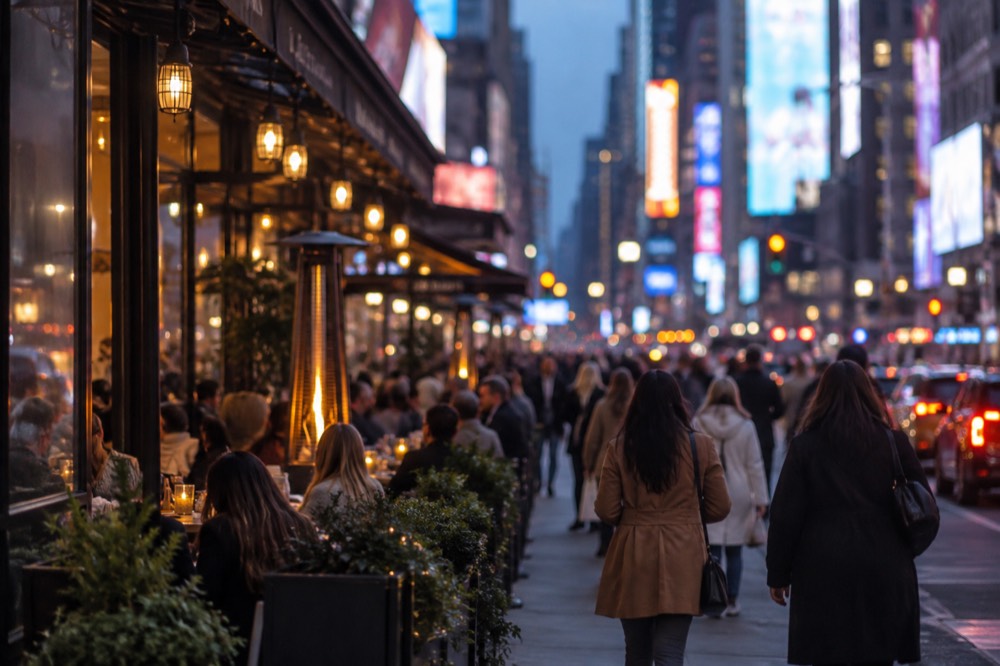
Most Broadway curtains rise at 8pm. That single fact shapes your entire evening, because it means dinner before a show is not really a question of cuisine, it is a question of clock management. A table at 7pm in the wrong part of Midtown is a gamble with your tickets. A table at 5:30pm two blocks from the theater is a relaxed meal.
The Theater District sits in Midtown Manhattan, roughly between 40th and 54th Streets around Broadway and 7th Avenue, and it is surrounded on nearly all sides by food. The problem has never been finding a place to eat. The problem is finding a place that can feed you, take payment, and let you walk to your seat with ten minutes to spare.
It is worth being honest about what this part of the city is. The blocks immediately around the theaters are not where New Yorkers eat on a night off. They are where the city feeds its visitors, efficiently and at scale, every single evening. That is not a criticism; it is a description of the machine. Once you understand that the district runs a nightly dinner rush that starts at 5pm and is largely finished by 7:15pm, you can plan inside it rather than against it.
This page works through the question the way a local would: timing first, then neighborhoods, then the booking order that saves the most hassle, and finally what to do when the timing simply will not cooperate.
How Early Should You Eat Before a Broadway Show?
For a standard 8pm curtain, you want to be seated at dinner no later than 5:45pm, and 5:30pm is the comfortable target. That gives a restaurant 90 minutes to feed you, which is enough for almost any kitchen, and leaves you a 15 to 20 minute walk to the theater. Matinee days flip the problem: a 2pm curtain means lunch at noon, and the post-show window is when the district empties out and tables open up again.
The math is simple but worth spelling out. Broadway houses start seating around 30 minutes before curtain, and the doors close once the performance begins. Some shows admit latecomers at a suitable break; many seat you in the back until intermission. Either way, you have paid full price for a seat you are not sitting in.
Service speed is the variable you cannot control. A kitchen running a full pre-theater rush can turn a two-course meal in an hour, but only if the kitchen knows you are theater-bound. Say it when you sit down. Restaurants in this part of Midtown handle pre-show diners every night of the week, and most will pace your table accordingly, or tell you honestly what is not achievable.
The reverse mistake is just as common: eating at 4pm to be safe, arriving at the theater an hour early, and spending the last of your appetite on a $14 bag of M&Ms from the lobby. Aim for the window, not the buffer.
There is a middle option that deserves more credit than it gets: a substantial snack at 4pm, no dinner, and a proper meal after the show. This works best for people who do not mind eating at 11pm, and it converts the pre-show scramble into a relaxed afternoon. It fails badly for anyone whose blood sugar crashes by 8:30pm, so know yourself before you commit to it.
Weekends change the calculus slightly. Saturday evening is the district's busiest slot, which means restaurants run at full tilt, waits stretch even with a reservation, and the walk to the theater is slower because the sidewalks are packed. On a Saturday, shave ten minutes off every estimate in this section. Midweek performances are the opposite: quieter restaurants, faster service, and a better chance of walking into a good place without a booking at all.
Where to Eat Before Going to a Broadway Show?
The three areas that work are Hell's Kitchen, the blocks of 9th Avenue west of the theaters, the Theater District's own restaurant rows around 46th and 47th Streets, and the quieter stretches of 8th and 9th Avenues. Hell's Kitchen offers the widest choice at the most reasonable prices, the restaurant rows closest to the theaters are built for the pre-show rush and take reservations with your curtain in mind, and 8th Avenue splits the difference.
Hell's Kitchen is the local default, and for good reason. It sits directly west of the theater blocks, so the walk after dinner is five to ten minutes for most houses, and the food runs from casual to serious along a handful of avenue blocks. Ninth Avenue in particular is dense with restaurants that do not depend on tourist traffic, which tends to show in both the cooking and the check.
The restaurant rows nearest the theaters are a different product. They are optimized for the 5:30-to-7pm wave, which means fast, competent service and menus designed to be finished in an hour. That is exactly what you want on a show night, even if the food is rarely the reason you would come back on a night off.
If you are already planning the whole evening, it is worth reading our companion piece on pre-show dining options near Broadway, which goes deeper on specific blocks, and our guide to getting cheap Broadway tickets, since the money you save on seats buys a better dinner.
One practical note on ticketing itself: the TKTS booths, at Duffy Square in Times Square and at Lincoln Center, sell same-day and next-day-matinee seats at discounts of up to 50% off face value, with an $8 per-ticket service fee. If your tickets are bought same-day at the booth, your dinner reservation is the one fixed point in the evening, so anchor the plan to the restaurant and let the show fall where it falls.
A note on walking routes, because Midtown's street grid has a few traps. The numbered avenues get wider and the blocks get longer as you go west, so a restaurant that looks "two blocks away" on the map can be a longer walk than it appears, especially in a crowd. Also, the blocks around Times Square itself are the slowest walking in the city on a show night; a route that skirts the square along 45th or 46th Street is usually faster than cutting straight through it, even if it looks longer on the map.
What Are the Best Pre-Theater Neighborhoods in New York?
Hell's Kitchen west of 9th Avenue is the best all-round pre-theater neighborhood for choice and price, the Theater District rows between 6th and 8th Avenues are best for proximity and speed, and Midtown East around 5th and Madison works only if your show is at one of the handful of houses that far east. Avoid anywhere that needs a subway ride between the table and the theater; a delayed train is how people miss overtures.
The comparison that matters is walk time against food quality against price, and the trade-offs are real. Here is how the main options stack up for an 8pm curtain.
| Area | Walk to most theaters | Character | Best for |
|---|---|---|---|
| Hell's Kitchen (9th Ave and west) | 5-15 minutes | Widest choice, local crowd, varied price points | Value and range |
| Theater District rows (46th-47th St) | 2-5 minutes | Built for pre-show dining, fast pacing | Zero-stress timing |
| 8th Avenue corridor | 5-10 minutes | Mix of casual and mid-range | A compromise on both axes |
| Midtown East (5th/Madison) | 15-25 minutes | Pricier, quieter, fewer pre-theater menus | Only for eastern houses |
| Bryant Park fringe | 10-15 minutes | Reliable chains and solid independents | Groups with picky eaters |
The rule behind the table: never let the dinner venue put a subway ride between you and the curtain. Walking distance is the whole point of eating near Broadway. A restaurant fifteen minutes away on foot is a plan; a restaurant ten minutes away by train is a hope.
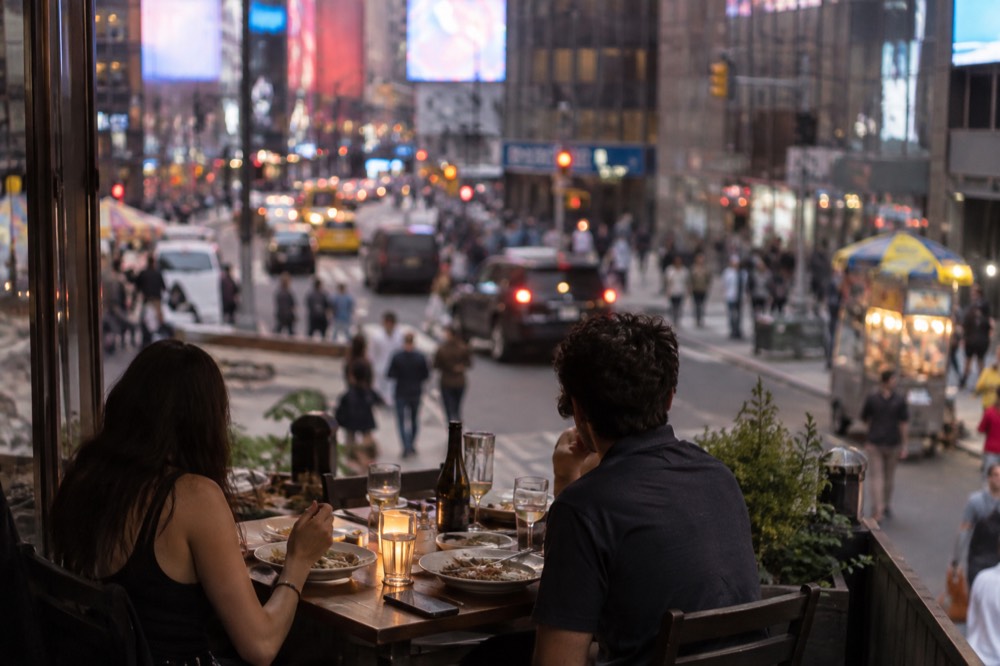
Within Hell's Kitchen itself, the character shifts block by block. The stretch of 9th Avenue in the 40s is the busiest and most varied, with everything from quick counter service to sit-down rooms that take reservations. A block or two further west, the pace drops and the prices often do too, at the cost of a slightly longer walk back to the theaters. If your show is at one of the houses on the eastern side of the district, closer to 6th Avenue or Broadway itself, the walk from 9th Avenue is at the top of the range, so budget the full fifteen minutes rather than the optimistic five.
Bryant Park deserves a specific mention for one kind of group: parties with divergent tastes. The blocks around the park hold a concentration of reliable, familiar operators where a table of six can each order something different without negotiation. It is not the most exciting food in Midtown, but it is the lowest-friction option when the group includes someone who considers adventure a form of punishment.
Should You Book the Restaurant Before or After You Buy Broadway Tickets?
Buy the show tickets first, then book the restaurant immediately, because the curtain time is the fixed constraint and the table is the flexible one. Once you know whether you are seeing an 8pm performance or a 2pm matinee, the dinner slot chooses itself: roughly 5:30pm for an evening show, noon for a matinee. Booking the restaurant first risks planning a lovely meal around a seat that does not exist.
The order matters more than people expect. Broadway tickets for popular shows sell by date and seat tier, and the performance calendar is the one thing you cannot negotiate. A restaurant, by contrast, will usually have some table at some time if you are flexible about the neighborhood. Other pages covering the same trip are gathered on New York City Travel Guide.
Once the tickets are secured, book the table with the curtain stated in the reservation notes. Pre-theater restaurants in this district see that note all day long, and it changes how the kitchen sequences your food. If you are seeing MJ the Musical, for instance, you know the running time is about two and a half hours, so a post-show drink is realistic but a post-show dinner is a late affair.
For families, the sequencing is even more important. Kids fade fast after 9pm, so a matinee with a big late lunch before it, or an early dinner after it, beats dragging hungry children through a 5:30pm meal they will pick at. Our guide to Broadway's biggest current shows notes which titles suit younger audiences.
One more sequencing note for anyone using a discount strategy. If you plan to try the TKTS booth for same-day seats, do not book a non-refundable restaurant for that evening until you have the tickets in hand, because the booth's inventory changes daily and your first-choice show may not be on the board. The booth publishes its live inventory online, so you can check the board before committing to dinner. A reservation you can cancel is the right instrument for a same-day ticket plan; a deposit you lose is not.
How Do Curtain Times and Running Times Change Your Dinner Plans?
A standard 8pm curtain with a roughly two-and-a-half-hour running time ends around 10:30pm, which means a post-show dinner is possible but limited, since many kitchens in the district stop taking orders around 10pm or 10:30pm. Matinees are the opposite: a 2pm show lets you eat a normal dinner hour afterward with no rush at all. The running time of your specific show is the number to check before you plan anything.
The three long-running musicals that anchor the district tell the story. MJ the Musical runs about two and a half hours, The Lion King about the same, and Wicked about two hours and forty-five minutes. None of them is a quick in-and-out, and all of them include an intermission, which is when the lobby bar does its best business and nobody regrets eating beforehand.
| Show | Approximate running time | Curtain-to-curtain finish (8pm start) | Dinner implication |
|---|---|---|---|
| MJ the Musical | ~2h 30m | ~10:30pm | Pre-show dinner; post-show drinks only |
| The Lion King | ~2h 30m | ~10:30pm | Pre-show dinner; a snack after |
| Wicked | ~2h 45m | ~10:45pm | Pre-show dinner firmly recommended |
The intermission is worth a mention because it changes what you eat before. A heavy meal at 5:30pm plus a bag of candy at intermission is a lot. A lighter pre-show meal, with the intention of a proper supper after, is a legitimate strategy, and New York supports it better than most theater cities, because plenty of places in Hell's Kitchen serve late.
Running time also matters for the pre-show hour in a subtler way. A show that runs long pushes your finish time past 11pm, which narrows the post-show options further, while a shorter show gives you a fighting chance at a kitchen that takes its last orders at 10:30pm. Check the running time on the listing when you buy, and treat it as a planning input, not trivia. The same logic applies to matinees in reverse: a 2pm curtain on a two-and-a-half-hour show puts you back on the street around 4:30pm, which lands you at the start of the dinner hour with the whole evening ahead of you. That is the single most relaxed way to see Broadway and eat well on the same day.
What About Eating After the Show Instead?
Eating after an 8pm Broadway show is a real option in New York, because the show ends around 10:30pm and Hell's Kitchen keeps late kitchens, but it requires knowing which places serve past 11pm rather than assuming the whole city waits for you. The post-show crowd is large and simultaneous, so without a plan you will be competing with half your theater for the same tables.
The simultaneous-exit problem is the thing to understand. When the curtains fall across forty theaters within the same half hour, the nearby restaurants absorb a wave. Places that welcome the post-show crowd are used to it and pace accordingly. Places that are not will tell you the kitchen is closed, politely, at 10:45pm.
Two strategies work. The first is to walk west into Hell's Kitchen rather than lingering in the blocks immediately around the theaters, where the wave is densest. The second is to book a late table in advance and say it is post-theater, which many restaurants in the district handle every night of the week.
A third strategy is the bar seat. A solo diner or a couple who takes two stools at a counter eats faster, later and with no reservation friction, and the kitchens that keep bar menus running past 11pm are disproportionately the ones that survive on the post-show trade. If your evening runs long and everywhere has stopped seating tables, the bar is where the city quietly keeps eating.
Whichever show you are seeing, the running time sets the shape of the late evening, so it is worth checking the specific numbers before you commit to a post-show plan rather than a pre-show one.
For families with younger kids, the post-show dinner is usually the wrong call. A child who has sat through two and a half hours of Wicked at 8pm does not want a restaurant at 11pm; they want a bed. The family move is the matinee plus an early dinner, or the early dinner plus the 7pm curtain where a show offers one.
Common Questions About Eating Before a Broadway Show in New York
The questions below cover the details this page gets asked most: how early to reserve, whether pre-theater menus are a trap, what to do about dietary needs, and whether it is better to eat before or after the curtain. Each answer gives the short version of a point made at length above, so you can check a single concern without rereading the whole page.
Where to eat before going to a broadway show?
Hell's Kitchen west of the theaters offers the widest choice at the best prices, the restaurant rows around 46th and 47th Streets are closest and fastest, and 8th Avenue splits the difference. Whichever you pick, be seated by about 5:30pm for an 8pm curtain and tell the restaurant you are theater-bound.
How early should I book a restaurant before a Broadway show?
Book the table as soon as your tickets are confirmed, and state the curtain time in the reservation. For a popular Saturday evening, that means booking days ahead. Midweek performances are more forgiving, but a pre-theater table in the district is never guaranteed on a walk-in basis at 6pm.
Are pre-theater menus a good deal?
Usually yes, if the timing works. A set pre-theater menu is designed to be served and finished inside 90 minutes, which is precisely your constraint, and the fixed price is often lower than ordering a la carte. Check that the menu has enough on it that you actually want to eat; a cheap menu you do not enjoy is not a saving.
Can I eat at the theater instead?
Theater concessions are snacks and drinks, not dinner, and lobby prices run high. Intermission at a big musical lasts long enough for a drink and a candy, not a meal. Plan dinner outside the house.
What if I have dietary restrictions?
Hell's Kitchen's density is your friend here, since a neighborhood with dozens of kitchens within a ten minute walk will include several that handle vegetarian, vegan, gluten-free or kosher needs well. Check menus online before booking, and mention the restriction when you reserve so the kitchen is not surprised at 5:45pm.
Is it better to eat before or after the show?
Before, for an 8pm curtain, because a 10:30pm finish means post-show dining is late and competitive. After, for a 2pm matinee, because you exit at 4:30pm into a normal dinner hour with no rush at all. The matinee-plus-dinner plan is the most relaxed show night New York offers.
The last word belongs to the clock, not the kitchen. Decide your curtain, work backward ninety minutes, pick a neighborhood you can walk from, and say the words "we're going to a show" when you sit down. Everything else on this page is detail; that sequence is the whole trick.