Is Albany, New York Worth Visiting?
An honest answer to whether Albany, New York is worth visiting, with what to see there, how to get there from NYC, and when a trip upstate makes sense.

Albany has been the capital of New York State since the eighteenth century, and it wears the job visibly: a government complex the scale of a small city, a Capitol building that took decades to finish, and a stack of state museums that cost less to enter than a single New York City observation deck. Yet almost every guide to New York written for tourists skips it entirely, because the tourists are far away in Manhattan, looking at a different skyline.
This page answers the question directly: is Albany, New York worth visiting? The short version is that it depends on what kind of traveler you are and how much time you have. For a first-time visitor with three or four days in New York City, Albany is not the right spend of a day. For a repeat visitor, a history-minded traveler, or someone with a week or more in the state, it is a genuinely rewarding and inexpensive stop that shows a side of New York most tourists never see.
The Short Answer for New York City Travelers
Yes, Albany is worth visiting, but not as a substitute for anything in New York City, and not as a rushed day trip. It earns its place when you have a week or more in New York State, an interest in government, architecture or history, or a reason to be up the Hudson anyway. As the state capital, with free state museums and a walkable historic core, it is far better than its reputation among downstate visitors suggests.
The honest framing matters here. Albany is not a rival to New York City, and comparing them is a category error. The city has eight million people, five boroughs and the busiest observation decks in the Western Hemisphere. Albany is a mid-sized state capital on the Hudson River, and its attractions are institutional rather than spectacular. What it offers is density of interest: a Capitol with a carved stairway that belongs in a European cathedral, a state museum, a performing arts venue, and a cluster of mid-century government towers that architectural fans either love or loathe.
The cost argument is real. Albany's state-run institutions are cheap or free to enter, food and lodging run well below Manhattan prices, and the city is compact enough that you walk almost everywhere once you arrive. A traveler who has already paid for the heavy New York City sights will find Albany a low-stakes, low-cost contrast.
If your trip is short, the calculus flips. A day spent on the train to Albany is a day not spent at the Metropolitan Museum of Art, the Statue of Liberty or the Brooklyn Bridge, and no honest guide should pretend the trade is even. Our things to do in NYC page exists precisely because the city itself can absorb every day of a first visit.
For travelers who have done the Manhattan circuit, or who are touring New York State more broadly, Albany slots in naturally alongside the Hudson Valley. It pairs well with the Hudson Valley day trips from NYC that run north along the same river, and it is a sensible anchor for a wider upstate loop.
What Albany Actually Offers
Albany's core attractions are the New York State Capitol, Empire State Plaza, the New York State Museum, Washington Park and the historic downtown streets near the river. Together they fill one full day comfortably and two days at a relaxed pace. The strongest single sight is the Capitol interior, and the strongest free sight is the State Museum, which covers the state's natural and human history.
The New York State Capitol is the building most visitors remember. It is one of the few state capitols without a dome, and its exterior is a wall of carved granite faces and detail. The interior staircase, a spiraling open stair with red marble and carved stonework, is the kind of space you expect in a European parliament, not a government office in upstate New York. Free guided tours run on weekdays, and the building sits at the head of State Street, the wide ceremonial avenue that runs downhill toward the Hudson.
Empire State Plaza sits next door. This is the modernist government complex, a long reflecting pool flanked by towers, with a modern art collection and an underground concourse of shops and food that connects the buildings in winter. Opinion on the architecture is genuinely split, but the scale is undeniable, and the plaza's observation deck gives a view over the city and the river. The Egg, the curved performing-arts venue at the plaza's end, is the complex's most recognizable silhouette.
The New York State Museum, on the plaza, is the value standout. It is a large museum covering New York's geology, wildlife and human history, with a full-sized carousel and exhibits on the Adirondacks and the city of New York itself. Admission is free, which makes it one of the cheapest substantial museum visits anywhere in the state. For a family, an afternoon here costs nothing but time.
Washington Park gives Albany its Central Park moment, smaller and calmer: a landscaped park with a lake, terraces and a tulip bed that anchors the city's spring Tulip Festival. The surrounding streets hold some of the city's best row-house architecture. The older downtown near the river, around Pearl Street and Broadway, carries the commercial bones of a city older than the republic, though the waterfront itself has been rebuilt and renewed in recent decades.
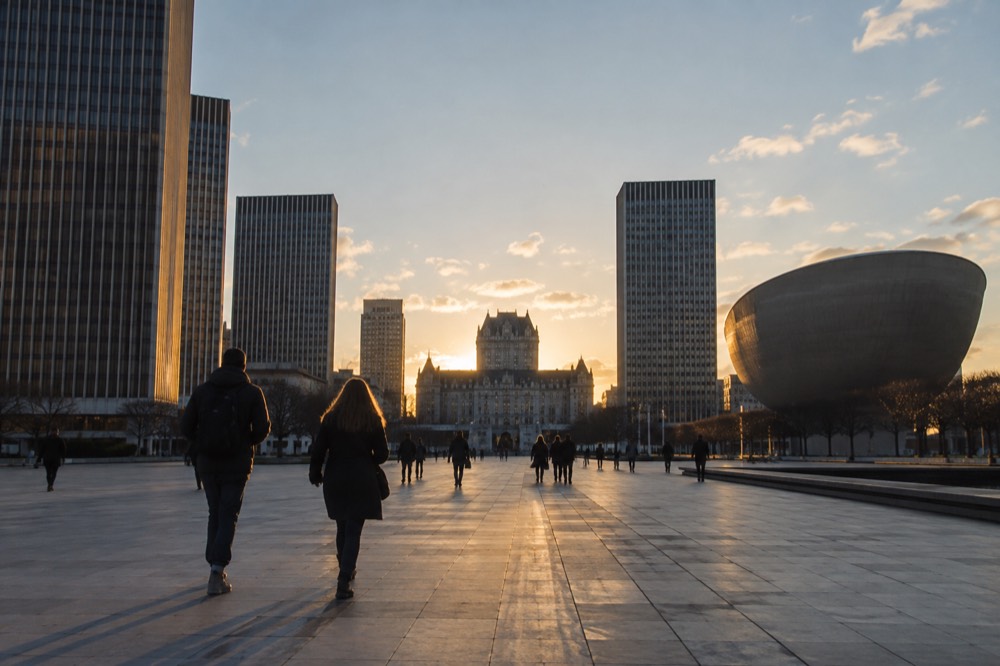
Here is how the main sights stack up for planning purposes:
| Sight | What it is | Time needed | Who it suits |
|---|---|---|---|
| New York State Capitol | Carved granite government building with free weekday tours | 1-2 hours | History and architecture fans |
| Empire State Plaza | Modernist government complex, art collection, observation deck | 1-2 hours | Architecture buffs, photographers |
| New York State Museum | Free museum of New York's natural and human history | 2-3 hours | Families, budget travelers, rainy days |
| Washington Park | Landscaped park, lake, tulip beds | 1 hour, more in spring | Anyone, especially in May |
| Downtown and Broadway | Historic streets, restaurants, the redeveloped riverfront | Half a day | Walkers, eaters, casual browsers |
How Do You Get from New York City to Albany?
The practical answer is the train. Amtrak runs direct service from Moynihan Train Hall, next to Penn Station in Manhattan, up the Hudson River to Albany-Rensselaer, and the ride is one of the most scenic rail journeys in the state. The train wins on comfort and views, the bus wins on price, and a car wins only if you plan to keep exploring beyond the city itself.
The Hudson River line is the reason to take the train. The tracks hug the river's west bank for long stretches, passing the Hudson Valley's estates, cliffs and small towns, and the scenery does most of the entertainment for you. Sit on the left side heading north for the better river views. The Albany-Rensselaer station sits across the river from downtown Albany, so budget for a short taxi or rideshare leg at the end.
Driving gives you freedom but costs you the views, since the driver watches the road. It also drops you into a small city where a car is useful mainly for excursions. If Albany is one stop on a wider upstate route, a car makes sense. If Albany is your only upstate destination, leave the car home and let the train do the work. This site's position on car hire is consistent: renting a vehicle is for day trips and upstate touring, never for getting around New York City itself, where the subway is the honest answer.
One thing to sort out before you leave Manhattan: how you are paying for transit in the city. The MetroCard is retired. As of 1 January 2026 the MTA no longer sells or refills them at all, and the weekly value now comes from automatic OMNY fare capping at $35, applied with no pass to buy. Tap the same card or device every ride and the cap takes care of itself. If you are heading upstate and returning, this is the system waiting for you when you get back.
If your wider trip includes several of New York City's big attractions before or after the Albany leg, a pass can change the math on the city portion. The New York CityPASS covers five attractions from a menu of eleven, including the Empire State Building, over nine consecutive days, which fits neatly around a few days upstate.
How Many Days Should You Spend in Albany?
One full day covers the Capitol, the plaza and the State Museum, with time for a walk through Washington Park if the weather holds. Two days let you add the downtown historic streets, the riverfront and a relaxed dinner scene without rushing. More than two days only makes sense if Albany is a base for exploring the surrounding region, including the Hudson Valley to the south and the Adirondacks and Saratoga to the north.
The one-day version is tight but real. Start at the Capitol for a weekday tour, cross to the State Museum for the middle of the day, walk the plaza, and finish in the park or downtown. It is a full schedule, and it works because everything sits within a walkable corridor. The failure mode is arriving late and losing the Capitol tour, which runs on weekdays, so an overnight Sunday-to-Monday plan can miss the interior entirely. Check the tour schedule before you lock dates.
Two days is the comfortable answer, and it is the one this site recommends for most travelers. Day one does the government core, day two does the neighborhoods, the riverfront and the food, with slack for weather and the museum's slower corners. Albany rewards a slower pace more than most small cities because its interest is concentrated in details, carvings, exhibits, streets, rather than in a single knockout view.
Longer stays are really regional stays. Albany is a sensible overnight base for the upper Hudson Valley, and travelers doing a wider New York State loop often break their journey here between the city and points north. If that is your plan, read our day trips from NYC overview for how the upstate options compare on time and effort.
When Is the Best Time to Visit Albany?
Late spring through early fall is the best window, with May the standout month because of the Tulip Festival in Washington Park and the city's Dutch heritage celebrations. Summer is warm and full of outdoor events, fall brings Hudson Valley foliage within easy reach, and winter is quiet, cold and best for the indoor sights like the State Museum and the Capitol. There is no bad month for the government core, since it is built for indoor visiting.
May is Albany's moment. The Tulip Festival, rooted in the city's Dutch founding, fills Washington Park with plantings and crowds, and it is the one weekend when the city feels like a destination rather than a workplace. Book lodging early for it. June through September are the reliable months for walking the plaza, the park and the riverfront, and the outdoor concert season runs through the summer.
Fall deserves special mention for a different reason. The Hudson Valley's foliage season is one of the best in the country, and Albany sits at the northern end of the corridor where the color arrives early. A late-September or October visit pairs the city's indoor sights with drives or train views through the hills, and the same logic that sends travelers to Sleepy Hollow and the Hudson Valley in autumn applies here one valley north.
Winter is honest work. Albany is a snow-belt city, and February in New York State is the snowiest month of the winter, a fact that surprises visitors who brace for January. The indoor core, Capitol, museum, plaza concourse, handles the cold well, and hotel prices drop. But the park and riverfront lose most of their appeal, so treat winter as a museum-and-government season.
A useful weather note for planners: the same official climate data that shows July as New York City's wettest month applies broadly to the region. Summer visitors should not assume dry days, and a rain plan built around the State Museum costs nothing to hold in reserve.
How Does Albany Compare with Other Trips from NYC?
Albany is a longer commitment than every popular day trip from New York City, and it should be weighed as an overnight, not a day out. Compared with the Hudson Valley towns, it offers more institutional weight and less scenery. Compared with Boston or Philadelphia, it is smaller and slower but far cheaper. Albany wins for repeat visitors and loses for first-timers on a clock.
The comparison that matters most is against the nearer Hudson Valley options. Towns like Cold Spring and Sleepy Hollow deliver river scenery, historic streets and a satisfying day trip inside a much smaller travel budget, and they do it without an overnight. Albany delivers the capital, the museums and the architecture, but you pay for both with more travel time. If you want scenery, stay south. If you want the state's institutional story, go the distance.
Against the big-city day trips, the trade is different again. Washington DC from New York City is a long coach or train day but returns you to Manhattan the same night, with the National Mall as the payoff. Boston and Philadelphia sit in the same category: heavy hitters, long days. Albany is not in that weight class, and pretending otherwise would be dishonest. What Albany offers instead is a calmer, cheaper, more local experience, and for some travelers that is exactly the point after a week of crowds.
| Trip from NYC | Rough commitment | What it delivers | Best for |
|---|---|---|---|
| Hudson Valley towns | Day trip | River scenery, historic streets, easy train access | First-time upstate visitors |
| Albany | Overnight, 1-2 days | State capital, free museums, architecture | Repeat visitors, history fans |
| Philadelphia | Long day trip | Independence Hall, dense history | History-focused first-timers |
| Washington DC | Long day trip or overnight | National Mall, monuments | Landmark collectors |
| The Hamptons | Full day | Ocean villages, outlet stops | Summer travelers with a car or coach |
The honest ranking for a first visit to New York is simple: the city itself first, the nearer day trips second, Albany third. The honest ranking for a second or third visit flips the bottom two, because the standard circuit is done and the question becomes what New York State is, and Albany answers that question better than anywhere else in the state.
If your Albany leg bookends time in the city, plan the city's eating around the neighborhoods rather than the tourist core. A guided food walk through Chinatown and Little Italy is a reliable way to eat well without gambling on random picks.
Common Questions About Visiting Albany, New York
The questions travelers ask most about Albany cluster around three doubts: whether it justifies the travel time from New York City, whether there is enough to fill more than a day, and whether it is worth the money compared with staying in Manhattan. The answers are yes with conditions, comfortably two days, and yes on cost, because the state museums are free and the city's prices run well below the city's. The details below take each question in turn.
Is Albany, New York worth visiting?
Yes, for the right traveler. Albany rewards visitors with an interest in government, architecture and New York State history, and it does so at low cost, with free state museums and walkable historic streets. It is not worth it as a rushed day trip from New York City, and it should not displace anything on a first-time Manhattan itinerary. As an overnight stop on a wider New York State trip, it earns its place.
Can you do Albany as a day trip from New York City?
Technically yes, practically it is a poor fit. The train journey each way eats several hours of your day, and the Capitol's free tours run on weekdays, which collides with most visitors' schedules. Treat Albany as an overnight stop. If you want a same-day return upstate experience, the nearer Hudson Valley towns are built for it.
What is the best thing to see in Albany?
The New York State Capitol interior. The carved stonework and the open spiral staircase are genuinely striking, and the free weekday tours explain a building that took decades to complete. The New York State Museum is the best free sight, and Washington Park in May, during the Tulip Festival, is the best seasonal moment.
Is Albany expensive to visit?
No, which is a large part of its appeal. The State Museum is free, the Capitol tours are free, and food and lodging run well below New York City prices. The main costs are the train or bus fare and your time. Compared with a day of Manhattan attraction tickets, Albany is one of the cheapest substantial stops in the state.
Is there enough in Albany for a weekend?
Yes. Two days covers the Capitol, Empire State Plaza, the State Museum, Washington Park, the downtown historic streets and the riverfront at a relaxed pace, with room for a second visit to anything that caught you. Beyond a weekend, you are really touring the region, the Hudson Valley to the south or the Adirondacks to the north, with Albany as the base.
What is the best month to visit Albany?
May, for the Tulip Festival and the park at its best, followed closely by any month from June through early October. Fall brings the Hudson Valley foliage season within easy reach. Winter is cold and snowy, and February is the snowiest month of the New York winter, so treat a winter visit as an indoor, museum-and-Capitol trip.
The final word is a planning word. Albany is the rare New York destination where the honest recommendation is also the generous one: go, but go with the right expectations, on the right schedule, and with the city's headline attractions already handled. Travelers who do that tend to come back saying the capital surprised them. Travelers who rush it as a box-tick tend to wonder why the train took so long. For more on shaping a New York trip that balances the city with the state around it, start with this New York City Travel Guide and build outward from there.