What Museum Opens in New York City on This Day in 1959?
The museum that opened in New York City in 1959 is the Solomon R. Guggenheim Museum, Frank Lloyd Wright's spiral landmark on Fifth Avenue. Here is the full answer, plus ticket prices, free hours and how to visit today.
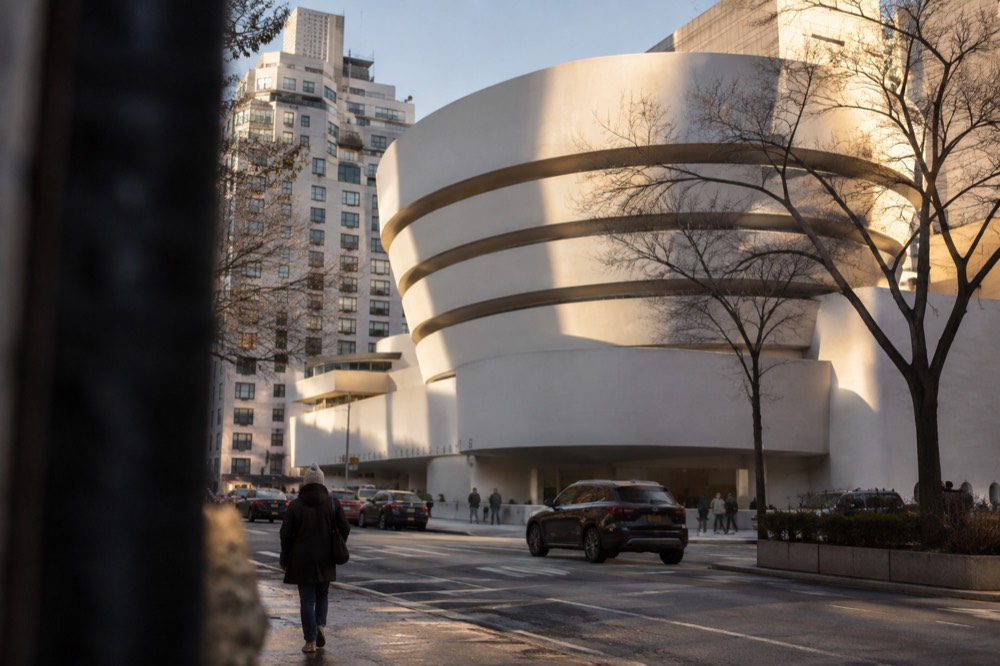
The museum that opened in New York City in 1959 is the Solomon R. Guggenheim Museum, the Frank Lloyd Wright spiral landmark that still stands on Fifth Avenue between 88th and 89th Streets on the Upper East Side. It is one of the few New York museums where the building itself draws as many visitors as the art inside it, and the answer to this question has stayed the same for decades even as the collection and the ticket prices around it have not. If you are planning a museum day around it, the Guggenheim tickets and visitor guide covers current hours and pricing in detail.
What Museum Opens in New York City on This Day in 1959?
The museum that opened in New York City in 1959 is the Solomon R. Guggenheim Museum, designed by Frank Lloyd Wright as a continuous spiral ramp wrapped around a central rotunda. It sits on Fifth Avenue on the Upper East Side and opened as the permanent home for Solomon R. Guggenheim's collection of non-objective painting. The building was controversial from the start, and it remains the most recognizable museum exterior in the city.
The question is a favorite of trivia pages and search engines because the answer is unusually tidy: 1959 is the Guggenheim's year, and no other major New York museum stakes a claim to it. The museum's founding collection was built around abstract and non-objective art, and the spiral building was designed so that visitors ride to the top and drift down a gently sloping ramp past the galleries, rather than working through a grid of rooms.
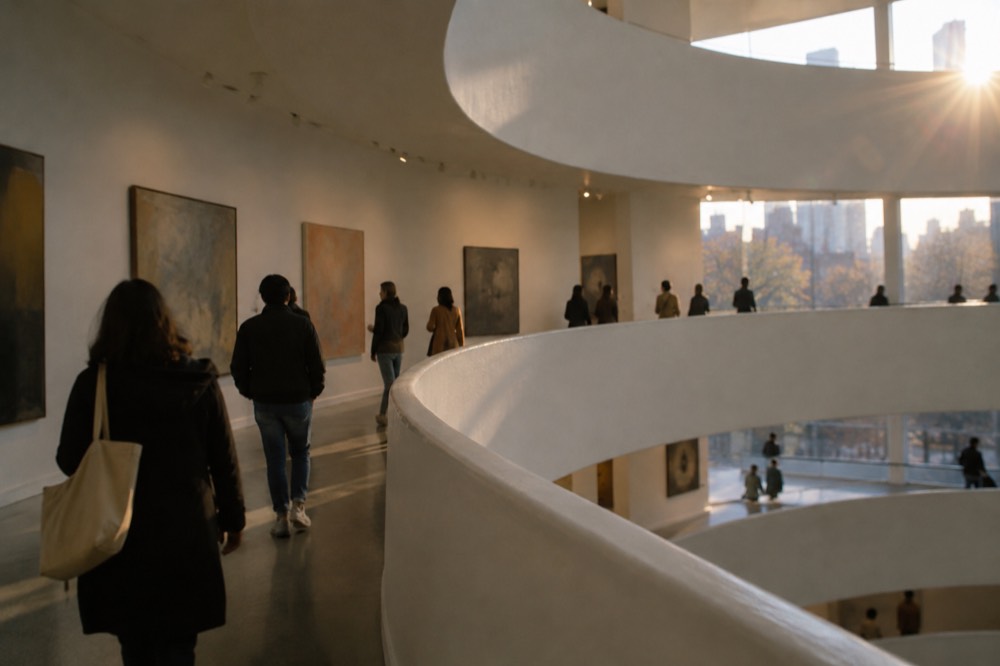
That single design decision is why the building still gets argued about. Some critics at the time thought the architecture overwhelmed the paintings hung on its curved walls. Visitors today mostly come for both at once: the rotunda views from each level, and the rotating exhibitions that fill the ramp. The museum's own current setup reflects that split, with a permanent collection on view alongside changing shows that periodically close parts of the galleries.
Frank Lloyd Wright's name is inseparable from the answer, and his spiral design is the reason the building reads as a landmark from the sidewalk before you buy a single ticket. The museum sits within a short walk of the Metropolitan Museum of Art further up Fifth Avenue, which makes this stretch of the Upper East Side the densest museum corridor in the city.
If the trivia answer sends you to the Upper East Side, it is worth knowing what the visit actually involves today: the ticket price, the free and reduced windows that most guides get wrong, and the closure schedule that can change what you see inside.
How Much Does It Cost to Visit the Guggenheim Museum Today?
Standard adult admission to the Guggenheim is $30, with a reduced $16 adult rate during exhibition changeover periods. Visitors aged 12 to 17 pay $19, children under 12 enter free, and pay-what-you-wish hours run Tuesdays and Sundays from 16:00 to 17:30, with a $1 minimum and a $10 suggested payment. Advance reservation is strongly recommended for those free windows because they sell out.
The pricing structure has two states, and which one you meet depends entirely on the exhibition calendar. The $30 standard rate applies when the full gallery program is running. The $16 reduced rate applies during changeover, when the museum is installing new shows and parts of the ramp are dark. Both are real prices at different points in the same scheme, so a review complaining about one or the other may simply have visited at a different moment in the calendar.
| Ticket | Price | Notes |
|---|---|---|
| Adult, standard | $30 | Full exhibition program running |
| Adult, changeover | $16 | Applies while shows are being installed |
| Ages 12-17 | $19 | $12 with student ID during changeover |
| Under 12 | Free | No ticket needed |
| Pay-what-you-wish | $1 minimum, $10 suggested | Tuesdays and Sundays, 16:00-17:30, advance reservation recommended |
The pay-what-you-wish windows deserve their own sentence because older guides get them wrong: the window is Tuesdays and Sundays in the late afternoon, not Saturday evening as some out-of-date sources still claim. A limited number of on-site tickets exist during the window, but the museum itself says advance reservation is strongly recommended, and the slots do sell out. Regular hours are 10:30 to 17:30 daily.
For visitors stacking several museums into one trip, a multi-attraction pass can beat individual tickets. The Guggenheim appears among the attraction choices on the New York CityPASS, which CityPASS lists with a $30.00 adult box-office value, the same figure the museum charges directly.
Why Is the Guggenheim's Building So Controversial?
The spiral design puts the architecture in direct competition with the art: paintings hang on continuously curving walls rather than flat ones, and the rotunda pulls your eye upward at every level. Critics at the time of the 1959 opening argued that a building this assertive would overwhelm the canvases, a debate that has never fully ended. Visitors now largely treat the building and the collection as a single experience.
The practical consequence for a visitor is that the Guggenheim does not behave like a room-by-room museum. You take the elevator to the top, then descend. The curved walls mean some works are seen at an angle, and the open center means you often see across the rotunda to galleries you have not reached yet. People who love the building describe this as part of the point. People who come strictly for the paintings sometimes find it distracting.
The controversy also had a practical benefit: it made the museum famous before most New Yorkers had seen the inside. The exterior alone, a smooth white coil set against the straight limestone apartment blocks of Fifth Avenue, draws sidewalk traffic that no conventional museum facade does. It is one of the few museums in the city where the exterior photo is genuinely half the visit.
Which Other Museums Should You Pair with the Guggenheim?
The Guggenheim sits on Museum Mile, a stretch of Fifth Avenue that also holds the Metropolitan Museum of Art, and the Met pairing saves the most money, because one Met ticket covers both Met Fifth Avenue and The Met Cloisters on the same day. MoMA in Midtown is the other natural companion, at $30 adult admission, though its free Friday evenings are reserved for New York State residents.
The Met is a ten-minute walk up Fifth Avenue, and its admission rules are the most commonly botched facts in New York travel writing. General admission is a fixed $30 for adults, $22 seniors, $17 students, free for children 12 and under. Pay-what-you-wish applies only to New York State residents and students from New York, New Jersey and Connecticut, and even then you must pay something, with a $0.01 minimum per ticket. Online pay-what-you-wish requires a New York State billing address, and New Jersey and Connecticut students must buy in person with valid student ID. Out-of-state visitors pay the fixed $30.
The same-day two-location rule is the detail most guides omit: every Met ticket includes same-day entry to both Met Fifth Avenue and The Met Cloisters, so a morning on Fifth Avenue can end in Fort Tryon Park for the price of one admission. The Met is closed Wednesdays, and a long list of galleries is currently closed for renovation, including parts of the American Wing, the Costume Institute and the Cantor Roof Garden, so check the museum's own gallery closures page before planning a visit around a specific wing.
MoMA rounds out the trio, and its free window has a residency catch too: the Friday-evening free admission from 17:30 to 20:30 is for New York State residents only, with proof required and tickets reserved in advance. Everyone else pays $30, with 16 and under free. MoMA sits in Midtown within walking distance of Rockefeller Center, which makes it easy to combine with an observation deck in the same afternoon.
| Museum | Adult admission | Free or reduced window | The catch |
|---|---|---|---|
| Guggenheim | $30 ($16 during changeover) | Pay-what-you-wish Tue and Sun 16:00-17:30 | Sells out, reserve ahead |
| Metropolitan Museum of Art | $30 fixed | Pay-what-you-wish for NY State residents and NY/NJ/CT students only | Must pay something, $0.01 minimum; proof required |
| MoMA | $30 | Free Fridays 17:30-20:30 | New York State residents only, proof required |
| American Museum of Natural History | Fixed price for visitors; pay-what-you-wish on general admission for NY State residents | NY State residents with ID | Pay-what-you-wish covers general admission only, not special exhibitions |
The American Museum of Natural History sits across Central Park on the Upper West Side, and its policy mirrors the Met's shape: general admission is pay-what-you-wish for New York State residents with ID, while everyone else pays a fixed price. That pay-what-you-wish option covers general admission only, not the special exhibitions, giant-screen films or planetarium shows that the all-inclusive ticket adds.
For a full rundown across the city, the museums in New York guide compares admission, hours and free windows museum by museum, and the wider things to do in NYC page places them in the context of everything else the city offers.
How Do You Get to the Guggenheim?
The Guggenheim is on Fifth Avenue at 89th Street, and the simplest subway approach is the 4, 5 or 6 train to 86th Street, then a short walk west to Fifth Avenue and three blocks north. A single subway or local bus ride costs $3.00, and fares now work entirely through OMNY capping: $35 per 7-day period on the same card or device, after which further rides are free.
There is no 7-day unlimited pass to buy any more, and that is the transport fact most guides still get wrong. The MetroCard was retired as a purchasable product on 1 January 2026: the MTA no longer sells or refills them, and the old 7-day unlimited pass does not exist. The replacement is automatic. Tap the same credit card, debit card, phone or OMNY Card at every ride, and once your taps total $35 within a rolling seven-day window, every further subway and local bus ride in that period is free. Twelve paid rides on the same device inside seven days hits the cap. The one rule that breaks it silently: mixing your phone and the plastic card in your pocket, because the cap only counts taps on one device.
For the museum corridor specifically, the 4, 5 and 6 trains run under Lexington Avenue, two avenue blocks east of Fifth. The M1, M2, M3 and M4 buses run along Fifth and Madison, useful in bad weather. Cabs and rideshares work but crawl on Fifth Avenue on weekend afternoons, and the subway is the honest answer for getting around the city generally; a rental car is for day trips out of town, not for Manhattan.
Visitors with reduced-fare eligibility pay $1.50 on the subway and local buses at all times of day. Children up to 44 inches tall ride free with a fare-paying adult, up to three children per adult.
Is the Guggenheim Worth Visiting in 2026?
Yes, for two kinds of visitor: anyone interested in architecture, because the spiral building is the exhibit even when galleries are between shows, and anyone planning a Museum Mile day who can time the pay-what-you-wish windows. The $16 changeover rate makes a between-exhibitions visit a genuine bargain, and under-12s enter free. Skip it only if you want Old Masters or dinosaurs, because the collection is modern and contemporary.
Timing is everything here. A visit during active changeover costs roughly half the standard rate, and the museum is upfront about why. If your priority is the building rather than a specific exhibition, that is the window to target, and the museum's own site shows which state is in force on your dates. If your priority is a particular show, book the standard ticket and go early in the day, because the ramp narrows with crowds.
The museum's hours are 10:30 to 17:30 daily, which pairs naturally with a morning at the Met a few blocks north: the Met opens at 10:00, closes at 17:00 most days and runs until 21:00 on Fridays and Saturdays, though it is closed Wednesdays. Doing the Guggenheim in the afternoon after the Met is the classic Museum Mile sequence, and it fits inside the walk between the two without any transit at all.
For families, the combination of free entry under 12 and a building that children find genuinely fun to descend makes the Guggenheim one of the easier art museums in the city with kids. The ramp does the entertaining, which lowers the stakes on the galleries.
What Else Was Happening in New York's Museum World Around 1959?
The Guggenheim's opening year sits inside the era that made Museum Mile what it is: the stretch of Fifth Avenue from the Met down through the Frick and up to the Guggenheim had already become the city's densest concentration of art institutions, and the spiral building completed it with a structure that functioned as a manifesto. The collection it housed was built around non-objective painting, the abstract work Solomon R. Guggenheim had spent decades assembling.
The useful frame for a visitor is that the Guggenheim was designed to be walked in one continuous descent, and that idea, art experienced as a single flowing loop rather than a sequence of rooms, is what traveled outward from 1959. Museum design since then keeps returning to it. Even museums that look nothing like the spiral borrow its logic: route the crowd one way, let the building pace the visit.
That is also why the trivia question has survived. Most "this day in history" answers point at events; this one points at a building you can still stand inside, on the same corner, paying a ticket and walking the same ramp. The answer to the question is not a ruin or a plaque but a working museum with a changeover calendar, a free window on Tuesday and Sunday afternoons, and a line on Fifth Avenue most mornings.
For anyone turning the trivia answer into a trip, the practical pieces are the ones that changed: the MetroCard is gone, the $35 OMNY cap replaced it, and the Guggenheim's own pricing runs on a two-state calendar you can plan around.
Common Questions About the Museum That Opened in New York City in 1959
Most questions about this trivia answer come down to three things: which museum it is, whether the building or the collection is the reason to go, and what a visit costs today. The Guggenheim is the answer to the 1959 question, the spiral is the reason most people go, and the current visit runs on a $30 standard ticket with a $16 changeover rate and free windows with conditions attached.
What museum opens in new york city on this day in 1959?
The Solomon R. Guggenheim Museum, Frank Lloyd Wright's spiral landmark on Fifth Avenue on the Upper East Side, opened in 1959 as the permanent home for Solomon R. Guggenheim's collection of non-objective painting. It still operates as a museum today, at 10:30 to 17:30 daily.
Who designed the Guggenheim Museum in New York?
Frank Lloyd Wright designed the Guggenheim Museum, a continuous spiral ramp wrapped around a central rotunda on Fifth Avenue. The design has visitors ride to the top and descend past the galleries rather than moving through a conventional sequence of rooms.
Can you visit the Guggenheim for free?
Only during the pay-what-you-wish windows: Tuesdays and Sundays from 16:00 to 17:30, with a $1 minimum and a $10 suggested payment. Advance reservation is strongly recommended and the slots sell out. Children under 12 enter free at all times.
How much are Guggenheim tickets?
Standard adult admission is $30, dropping to $16 during exhibition changeover periods when parts of the galleries are closed. Ages 12 to 17 pay $19, or $12 with student ID during changeover.
Is the Guggenheim worth it if an exhibition is changing over?
If your interest is the building, yes: the $16 reduced rate is close to half the standard ticket, and the rotunda, the ramp and the permanent collection remain the main draw. If you are visiting for a specific exhibition, check the museum's calendar and book a standard ticket instead.
What subway goes to the Guggenheim?
The 4, 5 or 6 train to 86th Street, then a short walk west to Fifth Avenue and three blocks north. A single ride is $3.00, and the $35 OMNY weekly cap applies automatically when you tap the same card or device for every ride.
The trivia answer is a building, and the building is open. Time the changeover calendar against your dates, take the 6 train, and walk down the ramp the way Frank Lloyd Wright intended, on a New York City Travel Guide note rather than a museum map.