Bryant Park: What a Visit Actually Involves, from Access to Timing
Bryant Park is the nine-acre green rectangle tucked behind the New York Public Library between 40th and 42nd Streets, and it is one of the few major Manhattan attractions that costs nothing to enter. This guide covers access, timing, what is actually in the park, and how to decide whether it belongs on your itinerary.
Short answer
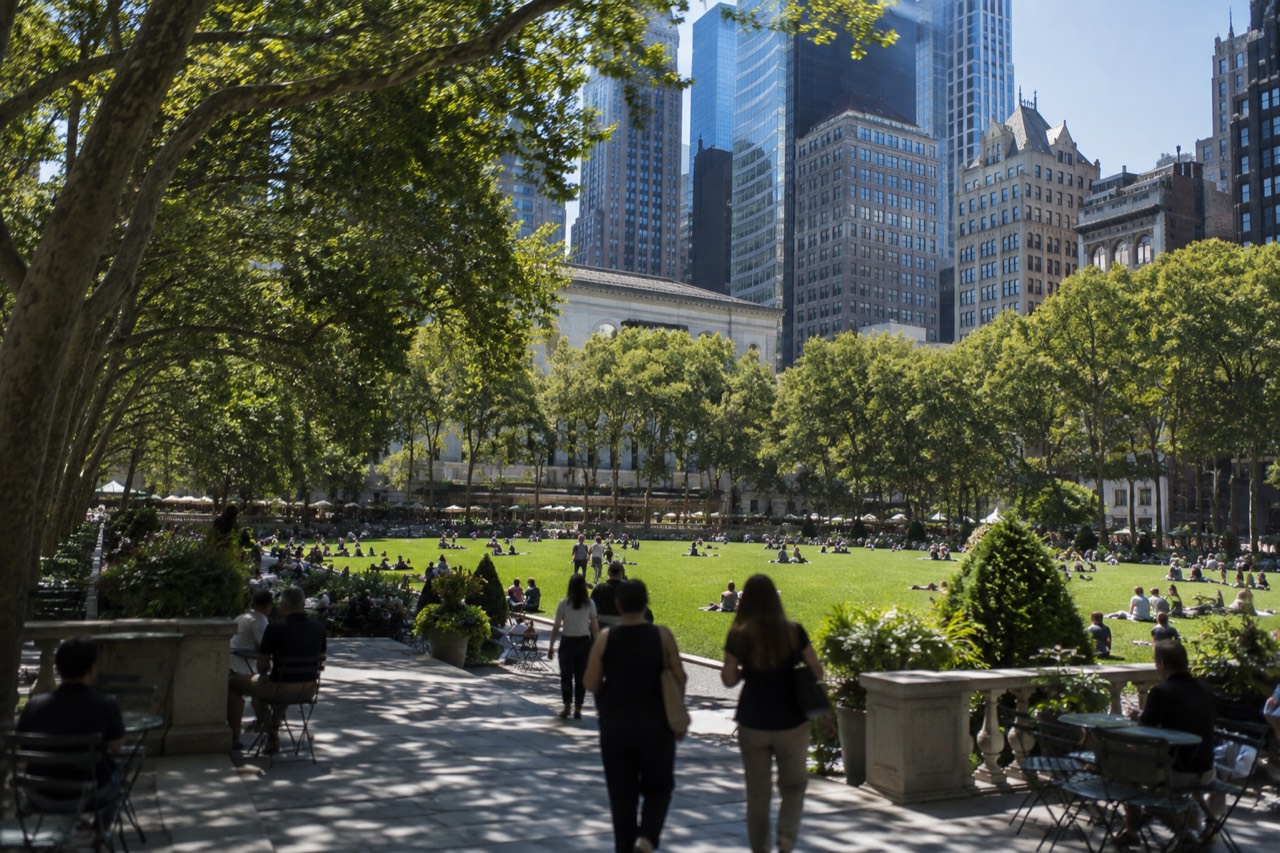
Bryant Park is free, open daily, and sits directly behind the New York Public Library at 42nd Street and Avenue of the Americas in Midtown Manhattan. The B, D, F and M trains stop at 42nd St-Bryant Park, one stop from Times Square. Expect lawn, tables, a carousel, food kiosks and, from late October through January, the Winter Village with its free-admission holiday market and ice rink.
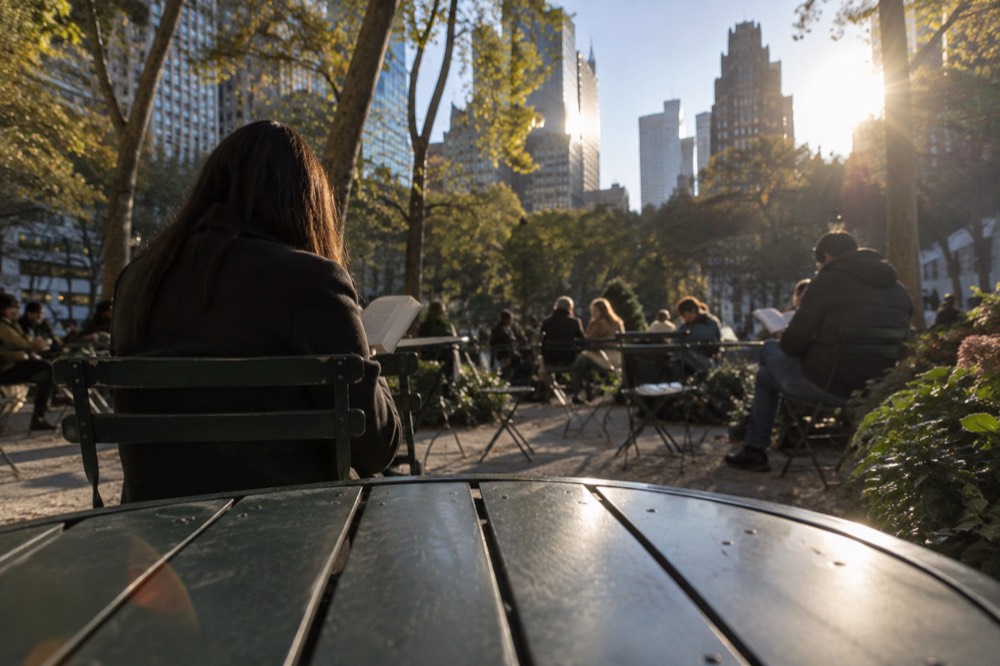
Most of Midtown is built to move you through it as fast as possible. Bryant Park is the exception: a rectangle of lawn, gravel paths and moveable chairs that asks you to stop. It sits behind the New York Public Library between West 40th and West 42nd Streets, boxed in by Avenue of the Americas on one side and the backs of office towers on the others, and it costs exactly nothing to walk into. No gate, no ticket, no queue.
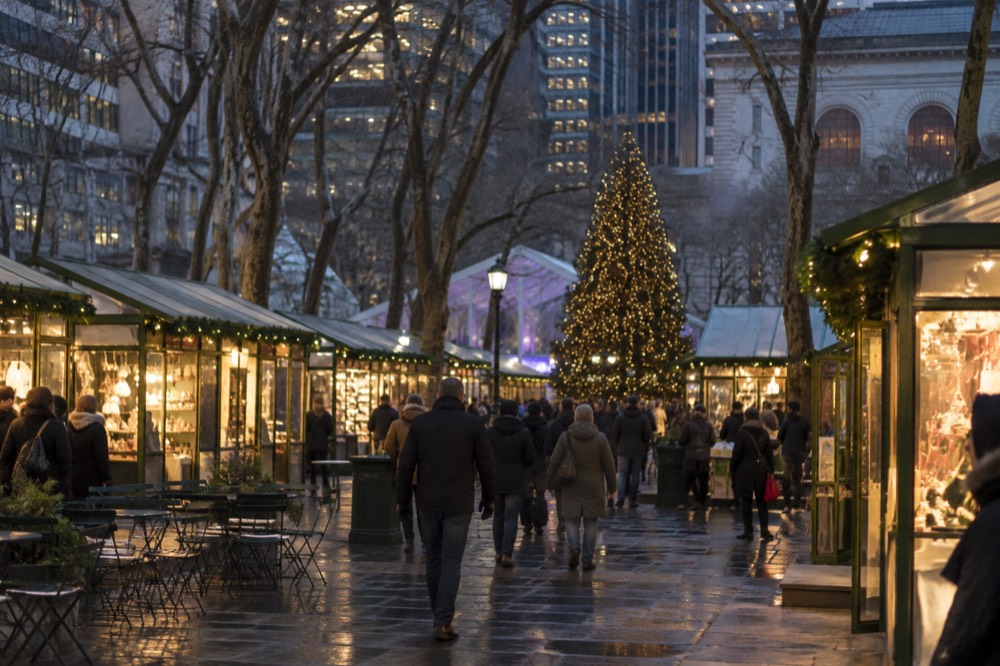
That free-and-central combination makes it one of the most-used patches of public space in Manhattan. Office workers eat lunch on the lawn in summer, tourists cut through between the library and Times Square, and from late October through the new year the whole park flips into the Winter Village, a holiday market and ice rink that draws crowds on the scale of a major attraction. This guide, part of the New York City Travel Guide attractions series, covers what a visit actually involves: getting there, what it costs, what you can do once inside, and how to judge whether it earns a slot in a day built around Midtown Manhattan.
Where Exactly Is Bryant Park?
Bryant Park occupies the block immediately behind the New York Public Library's main building, bounded by West 40th Street to the south, West 42nd Street to the north, Avenue of the Americas to the west and Fifth Avenue one block east. It is roughly nine acres of lawn and paths with no gates or ticket checks. Times Square sits two blocks west, and Grand Central is a short walk east.
The geography is the whole reason the park works. You are in the densest part of the island, a district of towers and crowd-control railings, and yet the block behind the library was kept as open lawn and sycamore-lined paths. The park's edges are porous on all four sides, which is worth knowing because the fastest approach is rarely the obvious one. Visitors walking up Fifth Avenue from the library often enter at the 40th Street corner; anyone arriving from the 42nd St-Bryant Park subway station surfaces directly onto the park's northern edge.
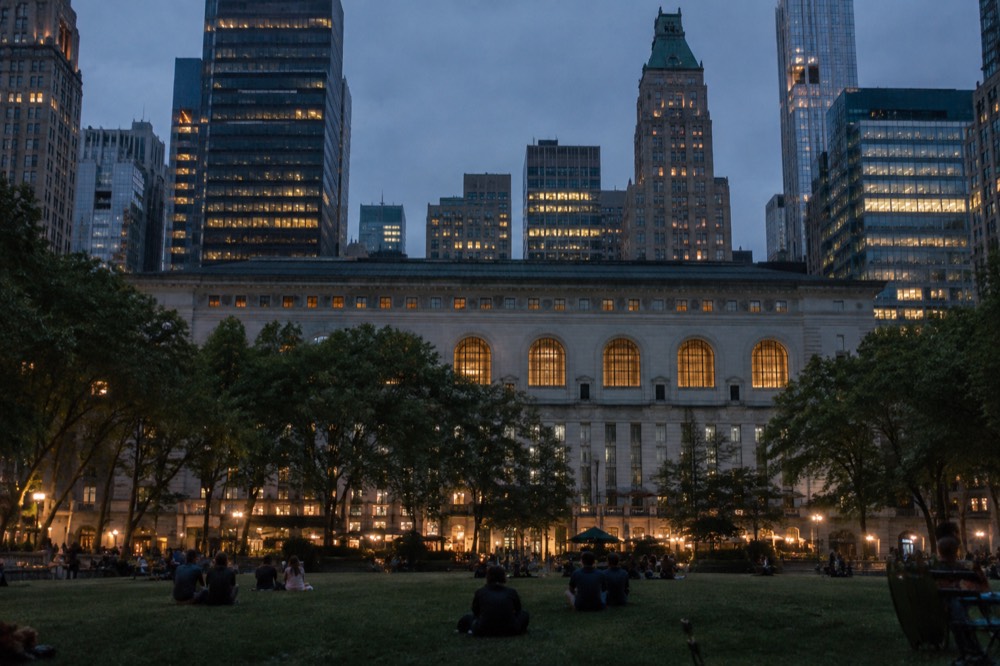
Two things anchor the block. The first is the library itself, whose marble rear facade rises over the south lawn and whose famous stone lions face Fifth Avenue, one block away. The second is the American Radiator Building, the black-and-gold Gothic tower on the park's southwest corner, which now operates as a hotel. Between them, the park reads less like a designed destination and more like a large shared backyard for the surrounding blocks, which is close to how New Yorkers actually use it.
If you are stringing Midtown sights together, the park slots naturally into a walking chain: the library, then the lawn, then west to Times Square, or east toward Grand Central. Nothing in that chain requires a vehicle, and all of it sits within about fifteen minutes on foot.
Is Bryant Park Free to Visit?
Yes, completely. Bryant Park is a public park with free access during opening hours, no admission fee and no ticket for the grounds, the lawn, the games tables or the reading room. Costs only appear if you choose them: the carousel and the Winter Village ice rink charge per ride or session, food kiosks charge menu prices, and market vendors sell at their own prices.
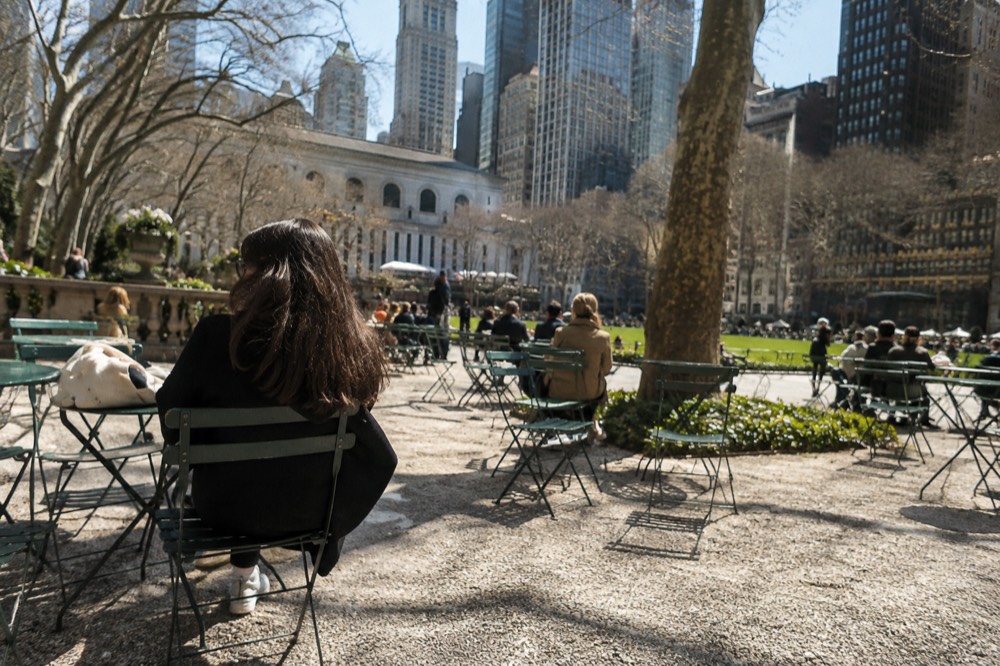
The free layer is thicker than most visitors expect. The park runs a lending operation of sorts: hundreds of moveable chairs and tables that anyone can claim, bocce and ping-pong equipment during the warmer months, a putting green in summer, and a reading corner with newspapers and books supplied in partnership with the library next door. The lawn itself opens for general sitting in spring through fall, closing only for maintenance or weather, and the park's programming, film nights, fitness classes, chess games, is offered at no charge.
The paid layer is small and optional. Here is the honest breakdown:
| Activity | Cost | Notes |
|---|---|---|
| Park grounds, lawn, chairs, tables | Free | Open to all during park hours |
| Games equipment (bocce, ping-pong, putting) | Free | Seasonal, borrow on site |
| Reading Room books and newspapers | Free | Weather-dependent, runs in warmer months |
| Carousel | Paid per ride | Check the operator's posted price at the carousel |
| Ice rink (late Oct to Jan) | Paid per session, skate rental extra | Admission to the Winter Village market itself is free |
| Food kiosks and bars | Menu prices | Prices set by each vendor |
| Winter Village holiday market | Free to enter | You pay only for what you buy |
One caution on the Winter Village: the market stalls are free to browse, but the ice rink is the park's main paid attraction in that season, and peak-session times around the holidays book out. If skating is the point of your visit, reserve a session before you travel rather than walking up on a December evening.
How Do You Get to Bryant Park?
The fastest way to Bryant Park is the subway: the B, D, F and M trains stop at 42nd St-Bryant Park, a station whose exits open directly onto the park's northern edge, and a single ride costs $3.00 with free transfers within two hours. The 7 train stops one block east, and Grand Central is a ten-minute walk. From Times Square the park is two blocks.
That last detail is worth dwelling on, because it shapes every visit. In 2025, the Times Sq-42 St complex recorded 61,203,303 riders against 35,764,931 at Grand Central-42 St, about 71% more, according to the MTA's own ridership data. The station two blocks from Bryant Park is the single busiest in the New York subway. What that means practically: the walk from Times Square to the park is short, but the platforms and passages feeding it are the fullest in the system, particularly around show times and weekend evenings.
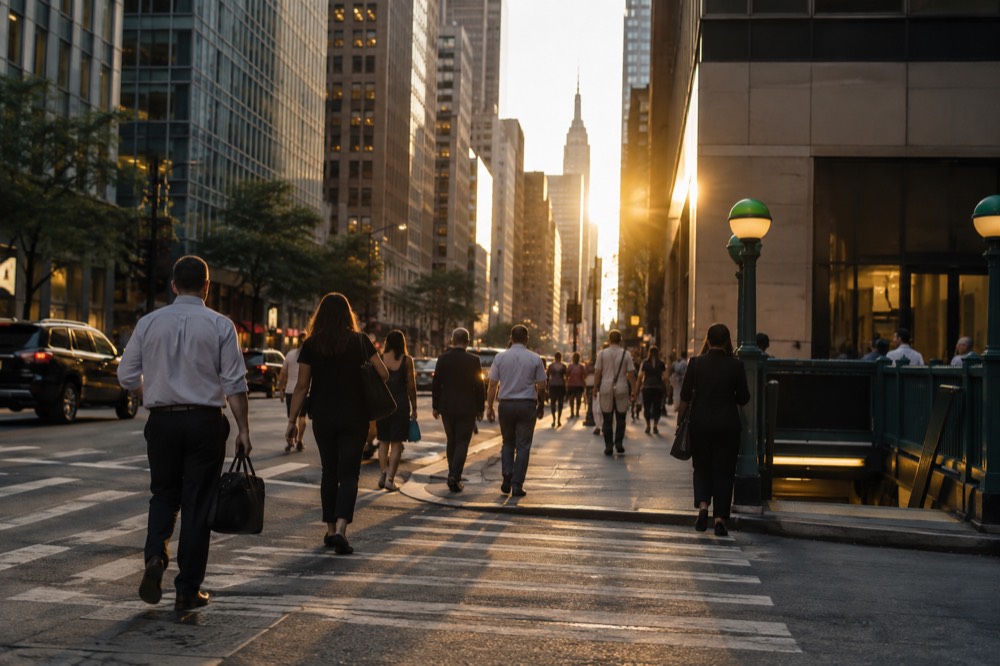
Fares are simple, and the old advice about buying a pass is now wrong. A single subway or local bus ride is $3.00. There is no 7-day unlimited MetroCard any more: the MTA stopped selling and refilling MetroCards on 1 January 2026. The replacement is automatic, you tap the same credit card, debit card, phone or OMNY card at every turnstile, and once your taps total $35 within a rolling seven days, the rest of that period is free. No pass to buy, nothing to activate. The one rule that trips people up: you must tap the same card or device every single time, because mixing a phone with the plastic card in your pocket breaks the cap silently.
For orientation, the station names tell you where you surface: 42nd St-Bryant Park exits at the park's north side, 5th Avenue on the 7 line puts you at the library's front steps, and Grand Central drops you east with a straight walk down 42nd Street. Coming from Central Park or the Upper West Side, the B or D trains deliver you without a transfer. Coming from Brooklyn, the F runs direct.
What Can You Actually Do at Bryant Park?
The honest answer is: low-key things, done well. Bryant Park's core attractions are the lawn, several hundred moveable chairs, the Reading Room, a carousel, seasonal games like bocce and ping-pong, free film nights and fitness classes in summer, food kiosks, and the Winter Village market and ice rink from late October through the holidays. There is no observation deck and no museum gallery. People come to sit, eat, read and people-watch.
A typical visit runs thirty minutes to two hours, depending on whether you sit down. The shortest meaningful loop: enter at 42nd Street, cross the gravel path past the carousel, walk the length of the lawn to the library's rear facade, and exit at 40th Street. That takes ten unhurried minutes. Everything beyond that depends on claiming a chair, and on a weekday lunch hour in June those chairs go fast, because the surrounding towers empty into the park at noon.
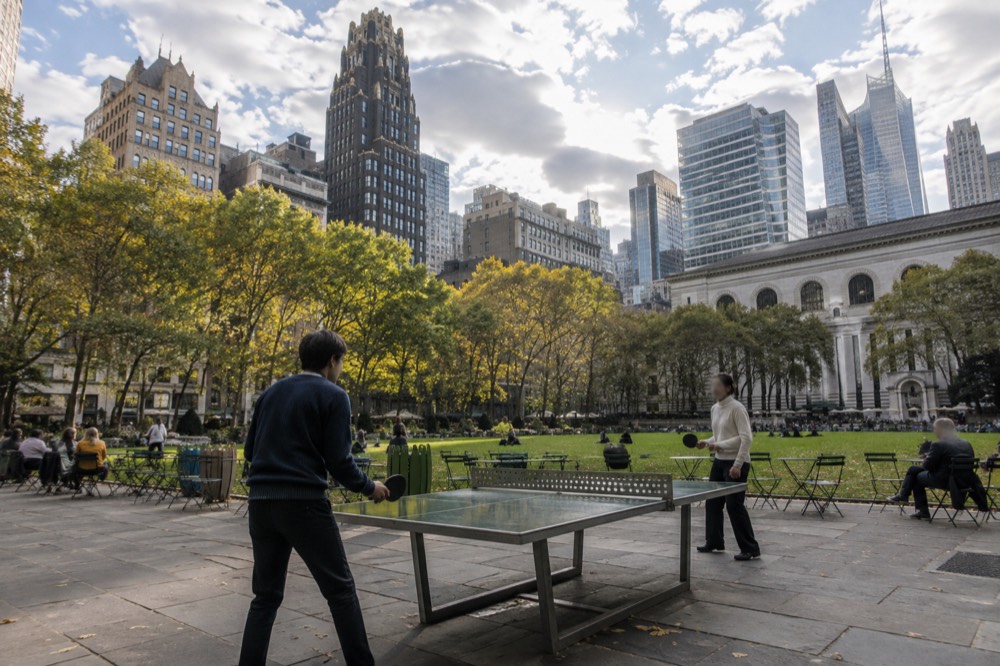
The seasonal rhythm changes the park more than most visitors expect:
| Season | What is in the park | Best for |
|---|---|---|
| Spring (Mar-May) | Lawn reopening, chairs out, Reading Room returns | Sitting, reading, a quiet lunch break |
| Summer (Jun-Aug) | Film nights, fitness classes, games, kiosks at full tilt | Evening movies, people-watching, free programming |
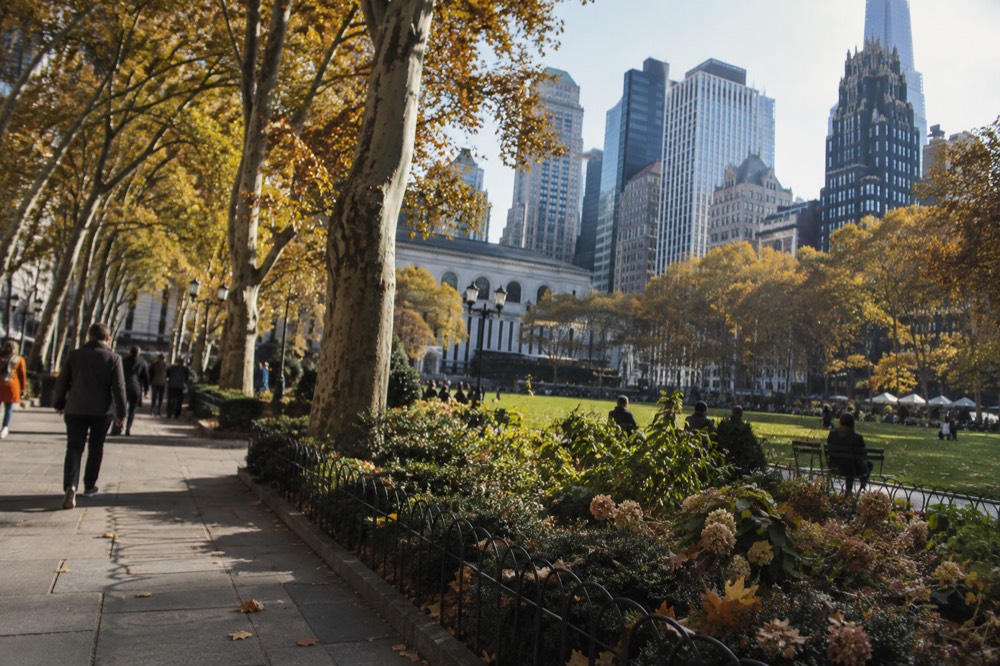
| Fall (Sep-Oct) | Lighter crowds, mild weather, market construction late Oct | The calmest pleasant weeks of the year |
| Winter (late Oct-Jan) | Winter Village market, ice rink, holiday crowds | Holiday shopping, skating, festive atmosphere |
| Late winter (Feb-Mar) | Market gone, rink closed, park resets | A quick cut-through, not a destination |
The Winter Village deserves its own warning about scale. Once the market opens in late October, the park stops being a quiet lunch spot and becomes a dense holiday attraction, with market stalls lining every path and the ice rink occupying the lawn. It is free to walk through, genuinely enjoyable, and extremely crowded from late November to early January, especially on weekend evenings. If you want the market without the crush, go on a weekday morning. If you want the park's everyday character at all, go before late October or after the new year.
For visitors who enjoy guided experiences more than self-guided sitting, the park is also a reasonable base for short tours. The carousel-and-lawn hour pairs well with a deeper walk elsewhere in the city, and travelers who want the big green space explained rather than discovered can book a guided route through Central Park's highlights; see the options below. Anyone weighing the two parks against each other should read the Central Park guide before committing scarce itinerary time.
The guided option is worth a moment of thought if your time in the city is short. Central Park is large enough that first-time visitors routinely get lost on its loops, and a guide who strings together Bethesda Terrace, the Mall and Bow Bridge in a single walk saves the map-reading hour that solo exploring usually costs. It is an easy fit for families too, since the paths are flat and the pace is set by the group.
When Is the Best Time to Visit Bryant Park?
The most pleasant window is May through early June and September through October, when Central Park weather averages daytime highs of 71.4°F in May and 76.2°F in September, with rainfall spread evenly rather than concentrated, and the lawn and chairs are fully in service. July and August are hotter, 84.9°F on average in July, and July is New York's wettest month at 4.60 inches of rain.
That July figure surprises people. The official NOAA 1991-2020 normals for Central Park put July at 4.60 inches of precipitation, the wettest month of the year, ahead of August at 4.56 and June at 4.54. Summer visitors who assume they have dodged the rain by avoiding spring are choosing the wettest stretch of the calendar. It rarely rains all day, but an afternoon downpour is a real possibility, and the park's lawn closes when saturated.
| Month | Avg high °F | Avg low °F | Precipitation (in) | Park conditions |
|---|---|---|---|---|
| April | 61.8 | 45.5 | 4.09 | Lawn reopening, chairs out |
| May | 71.4 | 55.0 | 3.96 | Excellent, long days |
| June | 79.7 | 64.4 | 4.54 | Hot afternoons, film nights begin |
| July | 84.9 | 70.1 | 4.60 | Wettest month, humid |
| August | 83.3 | 68.9 | 4.56 | Humid, free programming in full swing |
| September | 76.2 | 62.3 | 4.31 | Excellent, crowds thin |
| October | 64.5 | 51.4 | 4.38 | Excellent, market arrives late month |
| December | 44.3 | 33.8 | 4.38 | Winter Village, holiday crowds |
Time of day matters as much as season. Weekday lunch hours bring the office crowd, which is atmospheric if you want to see the park doing its real job and mildly annoying if you want a chair. Early mornings are the quiet hours, and in winter the market stalls are at their calmest before about 11am. Evenings flip the park's character: summer film nights fill the lawn with blankets, and the Winter Village glows after dark, at the cost of the day's biggest crowds.
One more data point that cuts against instinct: New York's subway is now relatively busier on weekends than weekdays compared with pre-2020 patterns, with 2025 weekend ridership at 88% of 2019 levels against 73% on weekdays. Practically, that means a Saturday visit to Midtown involves fuller trains than a Tuesday one, even outside rush hour. Midweek mornings remain the softest combination of weather, crowd and transit.
What About Food, the Carousel and the Winter Village?
Food in Bryant Park means kiosks and stalls rather than restaurants: coffee, sandwiches, ice cream, a wine and beer stand in warmer months, and a much larger food-and-market operation during the Winter Village, when dozens of holiday market vendors fill the paths. The carousel is a small paid ride suited to young children. The Winter Village, running late October through early January, offers free browsing and a paid ice rink.
In the everyday months, eating in the park is a grab-and-sit affair. You buy from a kiosk or, more commonly, from the delis and food carts on the surrounding streets, and you claim a table. The park's tables and chairs are the real restaurant: on any mild weekday, hundreds of people are eating lunches bought elsewhere across the park's gravel and lawn. That is the intended use, and no one checks where your sandwich came from.
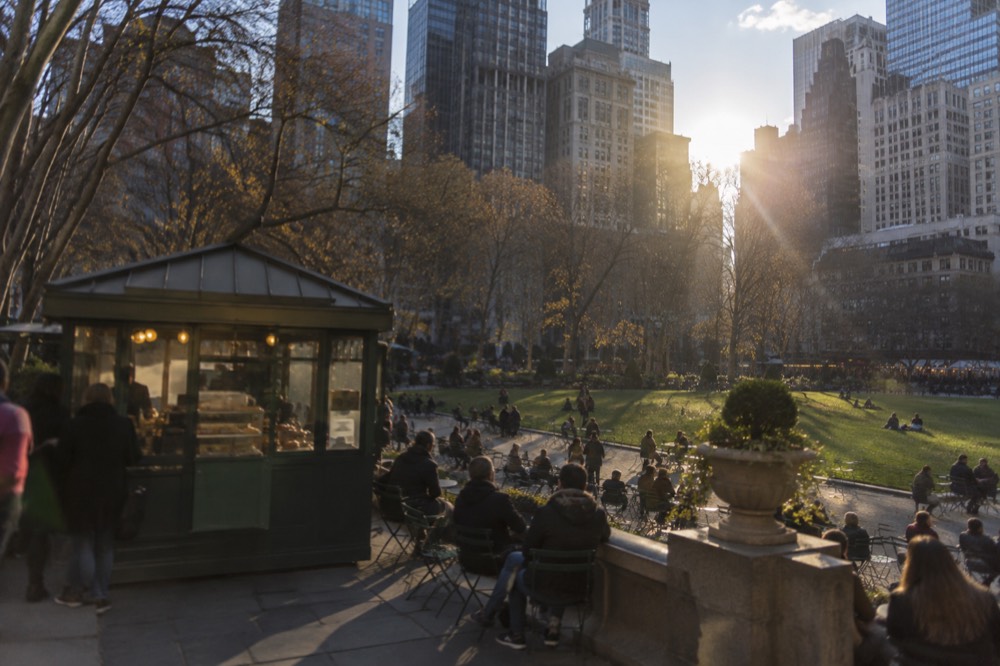
The Winter Village changes the equation entirely. The market's vendor lineup shifts year to year, so treat any specific stall list as a snapshot rather than a promise, but the shape is stable: gift and craft stalls along every walkway, hot food and mulled drink stands, and the ice rink where the lawn sits the rest of the year. Skating is the one activity worth booking ahead, because holiday-season sessions sell out and walk-up prices and availability at the rink window are worse than reserving. Admission to browse is free and always has been.
Visitors often ask whether the park is worth eating in versus the surrounding neighborhoods, and the honest answer splits by season. In summer, yes, easily: a kiosk lunch on the lawn is one of Midtown's better cheap pleasures. In deep winter, the market is more about browsing and a hot drink than a meal, and the surrounding blocks, including Koreatown one block west and the library-adjacent cafes, do full meals better.
For a food experience with more structure, the park's central location puts it within reach of the downtown eating tours, and the free-walk scene has grown strong options as well, including a tip-based bridge walk that pairs well with a Midtown morning. Both are listed here for travelers building a fuller day around the park's easy hour.
Is Bryant Park Worth Visiting?
For most visitors, yes, as a stop rather than a destination: Bryant Park earns thirty to sixty minutes in almost any Midtown itinerary because it is free, central, and one of the only places in the district where sitting down is the point. It is not worth traveling across the city for on its own. In late October through early January, the Winter Village upgrades the answer, with the caveat of holiday-level crowds.
The deciding factor is what else your day holds. If your itinerary already includes the library, Times Square, Grand Central or a Midtown observation deck, the park is effectively on your route, and skipping it would take more effort than passing through. The library pairing is the strongest: the building's interior is one of the city's great free interiors, and the park is its backyard, so the two together make a complete two-hour stop costing nothing.
Where the park falls short is as a substitute for Central Park, and some first-time visitors make that mistake because both are "parks." Central Park is a vast destination with lakes, woodlands, bridges and a zoo; Bryant Park is a nine-acre lawn with chairs. They are different products. If you have time for only one, Central Park wins on every measure except convenience to Midtown hotels, and even then Bryant Park's role is the quick stop, not the headline.
Travelers who want their park time guided have good options in both directions. A guided walking tour through Central Park's highlights, Bethesda Terrace, the Mall, Bow Bridge, solves the big park's navigation problem in about two hours, and a Grand Central secrets tour makes a natural Midtown pairing since the terminal is a ten-minute walk east. For a fuller rundown of every option in the city, the things to do in NYC page places Bryant Park in the wider context.
Whichever direction you take it, the pattern is the same: a short, expert-led walk turns a landmark you would otherwise photograph into one you actually understand. Grand Central rewards that treatment more than almost any building in the city, from the whispering gallery to the deliberate error painted into the celestial ceiling, and it sits close enough to Bryant Park to fill the same afternoon.
Common Questions About Bryant Park
Bryant Park is a free, gateless public park behind the New York Public Library, reachable directly by the B, D, F and M trains to 42nd St-Bryant Park for a $3.00 fare. It offers lawn, chairs, games, a carousel, kiosks and summer programming, plus the Winter Village holiday market and ice rink from late October through early January. The questions below cover hours, cost, skating and how the park compares with Central Park.
Is Bryant Park free?
Yes. The grounds, lawn, chairs, games equipment and Reading Room are all free, and there is no gate or ticket. You pay only for optional extras: carousel rides, ice skating, food and anything you buy from the Winter Village market stalls.
What subway goes to Bryant Park?
The B, D, F and M trains stop at 42nd St-Bryant Park, with exits on the park's northern edge. The 7 train stops at 5th Avenue one block east, and Grand Central is about a ten-minute walk. A ride costs $3.00, and the $35 weekly OMNY cap applies automatically when you tap the same card or device.
When does the Bryant Park Winter Village open?
The Winter Village typically runs from late October through early January, with the holiday market free to browse and the ice rink operating as a paid attraction. Exact opening dates shift each season, so check the park's official site before planning a dedicated visit, and book skating sessions ahead for the holiday weeks.
Can you eat in Bryant Park?
Yes, and that is largely the point. Kiosks sell coffee, sandwiches and snacks in the warmer months, and the Winter Village adds a much larger food operation. Many visitors simply buy from delis or carts on the surrounding streets and claim one of the park's tables or a spot on the lawn.
Is Bryant Park worth visiting compared with Central Park?
They are different things. Bryant Park is a nine-acre Midtown lawn built for sitting, and it earns thirty to sixty minutes in almost any Midtown day. Central Park is a vast destination that can fill half a day or more. If your itinerary passes through Midtown anyway, do Bryant Park as a stop; do not treat it as a substitute for the big park uptown.
What is the best time of day to visit Bryant Park?
Early mornings are the quietest in every season. Weekday lunch hours bring the office crowd, which is lively but competitive for chairs. Summer evenings are best for the free film nights, and in Winter Village season, weekday mornings offer the market with the fewest people.