Best Bagels in NYC: Where to Find Them and How to Order
New York runs on bagels the way other cities run on coffee, and the gap between a great one and a mediocre one is wide enough to plan a morning around. Here is what actually separates the best bagels in NYC from the rest, where to look, and how to order without causing a scene.
Short answer
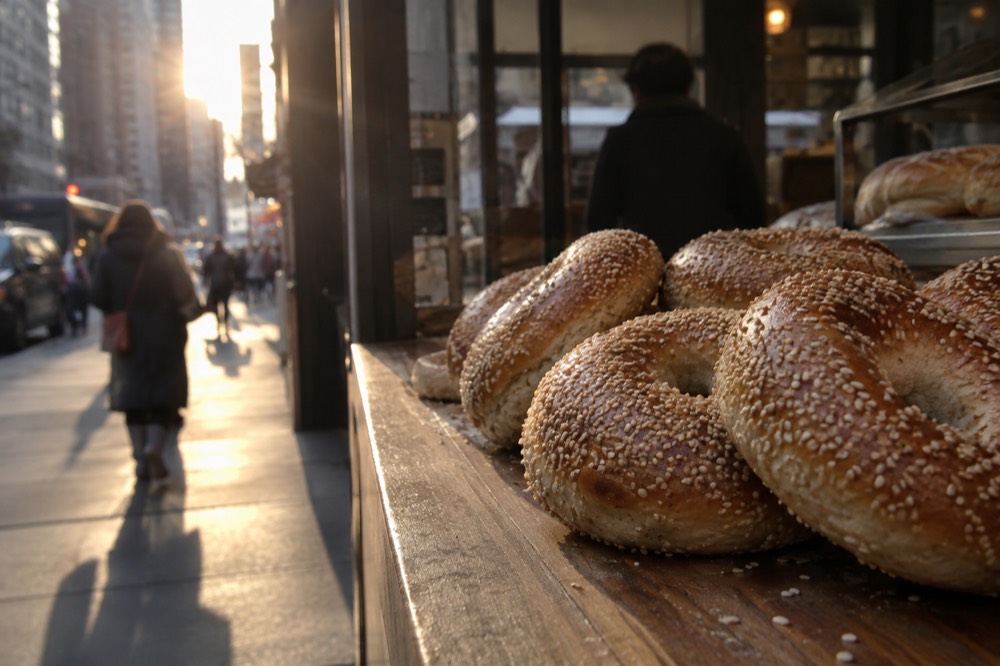
The best bagels in NYC come from shops that boil their bagels before baking them, turn over hot batches all morning, and pull them fresh rather than letting them sit. Look for hand-formed rings with a crackled crust and a dense, chewy interior, and order by the bagel first, the preparation second.
New York produced roughly 1.28 billion subway rides in 2025, and an uncountable but certainly enormous number of those riders were holding a bagel. The two facts belong together. A bagel is not a souvenir food here, it is infrastructure, the thing the city eats standing up, on a bench, or at a counter before nine in the morning. And the strange truth about it is that the product varies more wildly from shop to shop than almost anything else you can buy for a few dollars in this city. One counter hands you a crackled, malty, chewy ring still warm from the oven. The next hands you something closer to a bread roll with a hole in it.
This guide, from the New York City Travel Guide desk, is about telling those two counters apart. It covers what actually makes a New York bagel different, which neighborhoods and shops are worth the detour, how to order without drawing sighs from the person behind the counter, and how to fold a bagel stop into a day that also includes museums, decks, and neighborhoods worth walking. Nothing here requires a car. The subway reaches every shop mentioned, and at $3.00 a ride with a $35 weekly cap through OMNY, it is cheaper than parking anywhere in Manhattan would ever be.
What Makes a New York Bagel Different?
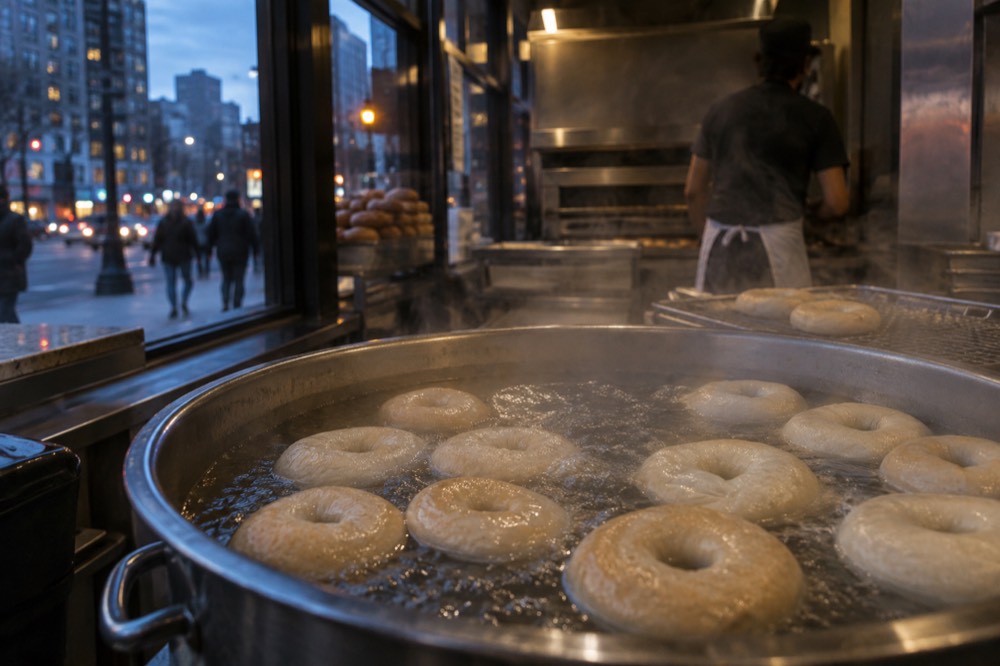
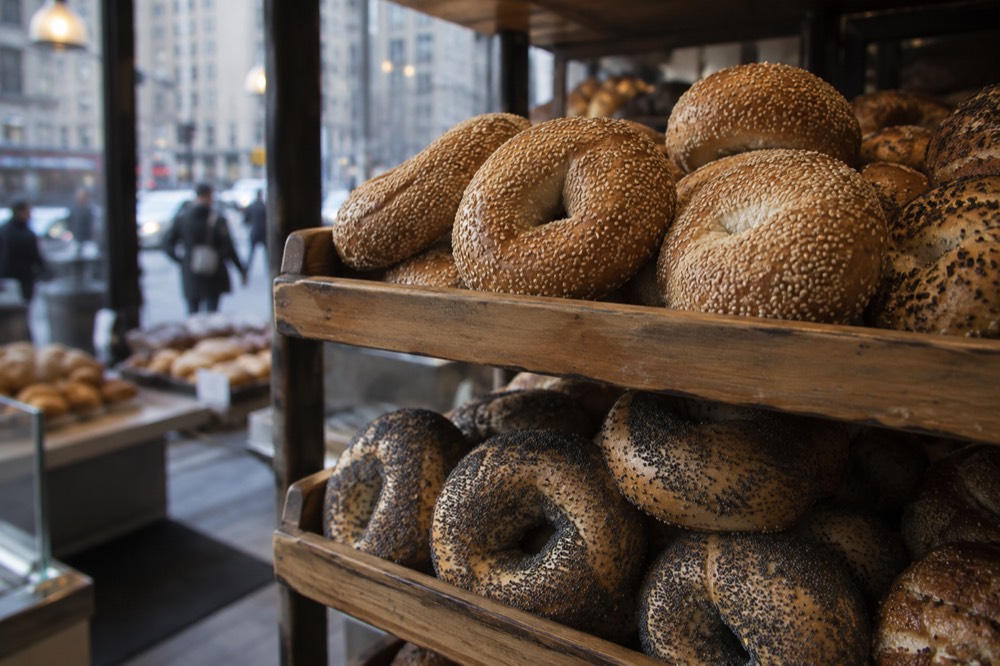
A real New York bagel is boiled briefly in water before it is baked, which sets a thin, glossy, slightly crackled crust around a dense and chewy interior. Shops that skip the boil, or that steam instead, produce a softer, bready ring that most locals can identify in one bite. Freshness matters as much as method: a bagel pulled from the oven within the last hour tastes meaningfully different from one that has sat in a basket all morning.
The boil is the whole story. Dough that goes into water first develops a skin, and that skin is what gives a proper bagel its snap when you tear it. The interior never quite inflates the way loaf bread does, so it stays dense and chewy instead of turning spongy. Bakers sometimes add a little malt or barley syrup to the boiling water, which contributes the faint sweetness and the deep brown color on top of the crust.
The second thing is turnover. A bagel has a short peak. Baked at six in the morning and eaten at six fifteen, it is one of the best things in the city. Eaten at eleven, it is noticeably stiffer. Eaten at three in the afternoon, it is a different product entirely. The best shops in New York are not necessarily the ones with the most famous names, they are the ones baking in small batches all morning so that the odds of getting a hot one stay high. If you walk past a shop and smell the oven, that is the shop.
Size and shape tell you something too. A hand-formed bagel is slightly irregular, with a tighter hole and a lumpier profile than a machine-extruded one. The giant, puffy, uniformly round bagels that have spread across the country in recent decades are a different food, softer and sweeter, and New Yorkers tend to treat them with polite suspicion. Here, a good bagel fits in one hand.
Where to Find the Best Bagels in Manhattan
Manhattan's strongest bagel counters cluster downtown and on the East Side, with long-running shops in the East Village, the Lower East Side, and Midtown that still boil and bake on premises. The names that come up again and again among locals are Ess-a-Bagel, Russ & Daughters, Tompkins Square Bagels, and Best Bagel & Coffee, and each earns its reputation on freshness and texture rather than decor. Expect lines on weekend mornings and a counter rather than table service.
The East Village and Lower East Side are the historic heartland. This is where the bagel tradition took root in New York, carried by the immigrant bakers who made the city's bagel culture what it is, and the neighborhood still supports a dense concentration of dedicated bagel shops within a few walkable blocks. If you are staying downtown, you can hit two or three counters in a single morning and run your own comparison. That is a legitimately good way to spend a Saturday.
Midtown is more of a mixed bag, because the neighborhood's volume rewards speed over craft, and a lot of the bagels sold to tourists near the major attractions are baked off-site hours earlier. The counterpoint is Ess-a-Bagel near Madison Square, which has held its standard while feeding an office crowd. The practical rule for Midtown: walk a few blocks away from the hotel strips and look for the shop where the line is mostly people carrying briefcases rather than maps.
The Upper West Side and Upper East Side both hold their own, which matters if your day is built around Central Park or Museum Mile. A bagel before the American Museum of Natural History or the Metropolitan Museum of Art is a classic New York sequence, and both neighborhoods have counters that boil on premises. Since the Met's admission is $30 for adults and one ticket covers both the Fifth Avenue building and The Met Cloisters on the same day, a morning bagel run paired with an afternoon of galleries is an efficient and genuinely local way to spend a day.
| Shop | Neighborhood | What to expect |
|---|---|---|
| Ess-a-Bagel | Midtown / Gramercy | Large hand-rolled bagels, thick crust, big lunchtime lines |
| Russ & Daughters | Lower East Side | Appetizing shop tradition, smoked fish, sit-down café nearby |
| Tompkins Square Bagels | East Village | Wide selection, casual counter, strong neighborhood following |
| Best Bagel & Coffee | Midtown / Murray Hill | Fresh batches through the morning, classic preparations |
| Absolute Bagels | Upper West Side | Small shop, devoted local following near Columbia |
Where to Find the Best Bagels in Brooklyn and the Outer Boroughs
Brooklyn holds some of the city's most devoted bagel followings, with strong counters in Park Slope, Williamsburg, and along the southern Brooklyn avenues where the tradition runs deepest. Queens and the Bronx have their own serious shops, often with shorter lines and lower prices than Manhattan. If your itinerary already includes Brooklyn, the bagel stop should be planned there rather than back across the river.
Brooklyn's bagel culture is not a copy of Manhattan's, it is a parallel tradition, and many locals will tell you the borough's best exceeds anything across the bridge. The neighborhoods along the subway lines that feed into downtown Brooklyn have supported family-run counters for generations, and the shops that survive there do so on regulars rather than foot traffic. That changes the product. A shop that can count on the same faces every morning has no reason to cut corners on the boil.
Williamsburg works especially well for visitors because the bagel stop can be folded into a neighborhood walk. If you are crossing the Brooklyn Bridge on foot, a route through DUMBO and up into Williamsburg passes several good counters, and the Brooklyn Bridge walking tour pairs naturally with a late-morning bagel. Park Slope, a short walk from Prospect Park, is the other reliable cluster, with shops that fill early on weekends and empty by early afternoon.
Queens is the sleeper. The borough's best shops sit along avenues where a bagel counter is a neighborhood institution rather than a destination, and the lines move fast because everyone in them is on their way to work. If you are already heading to Astoria or Jackson Heights for the food, and you should be, the bagel stop costs you nothing in extra travel. The Bronx and Staten Island both have their partisans too, and a Staten Island Ferry morning, which is free, can be combined with a bagel before boarding.
How to Order a Bagel in New York Like a Local
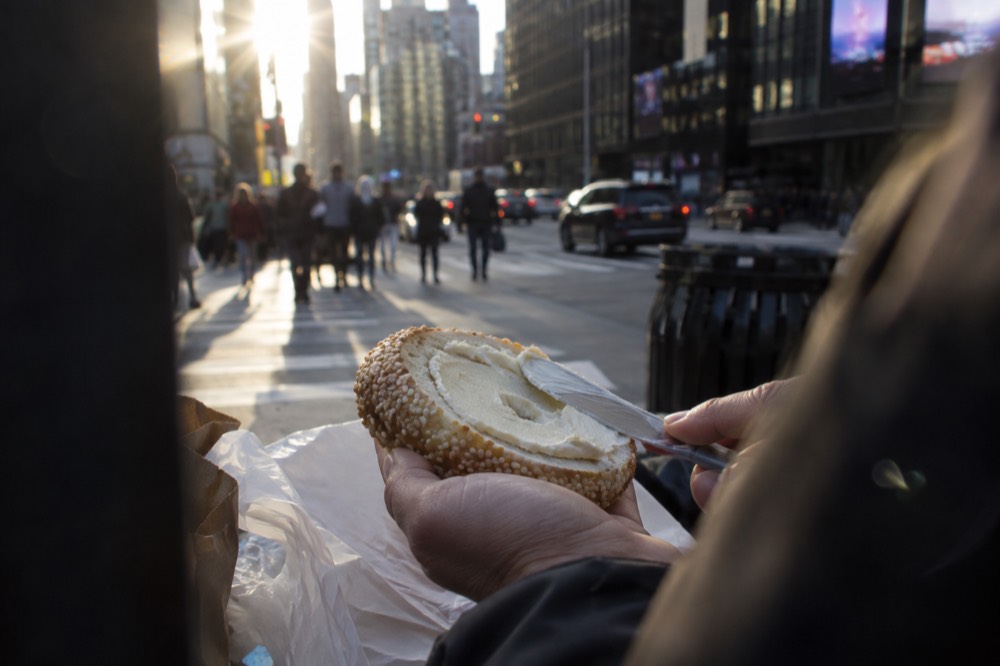
Order the bagel first, then the preparation: "a sesame bagel with scallion cream cheese, toasted" is a complete, correct order. Saying "a bagel with cream cheese" without naming the bagel will get you asked which one, and asking for a scoop of plain cream cheese on the side marks you as an outsider. Toasting is accepted but optional, and on a genuinely fresh bagel most regulars skip it.
The vocabulary is small but it is load-bearing. A "whole" everything bagel is one with seeds on both sides rather than just the top. A "scooped" bagel has some of the interior bread removed to cut the calories and make room for filling, and asking for it will quietly signal that you know what you are doing. "Toasted" is fine, but counter staff will sometimes note, accurately, that a bagel fresh out of the oven does not need it. If it came out of the oven more than an hour ago, toast it.
| Term | What it means |
|---|---|
| A scoop | A portion of cream cheese, roughly enough for one bagel |
| Toasted | Run through the oven again; ask for it on anything not fresh |
| Scooped | Interior bread removed before filling |
| Whole | Seeds or topping on both faces of the bagel |
| Open-faced | One half, topped, served as a plate rather than a sandwich |
| A sandwich | Bagel plus egg, cheese, or deli meat, pressed or not |
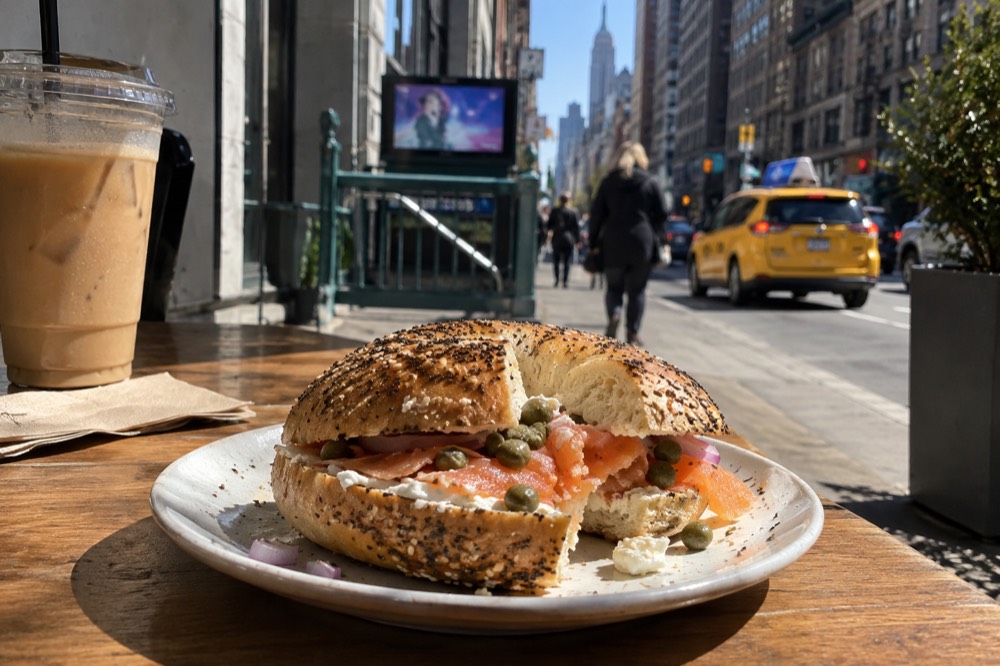
Cream cheese is where visitors most often go wrong, in the generous sense. A New York counter stocks a dozen varieties, from scallion to olive to the everything-flavored spreads, and the default quantity applied is substantial. If you want less, say "easy on the cream cheese." If you want none, say "dry." The lox order deserves special attention: a bagel with lox, cream cheese, capers, and onion is one of the city's great foods, and Russ & Daughters, which began as an appetizing shop serving exactly this, treats it as a craft rather than a sandwich.
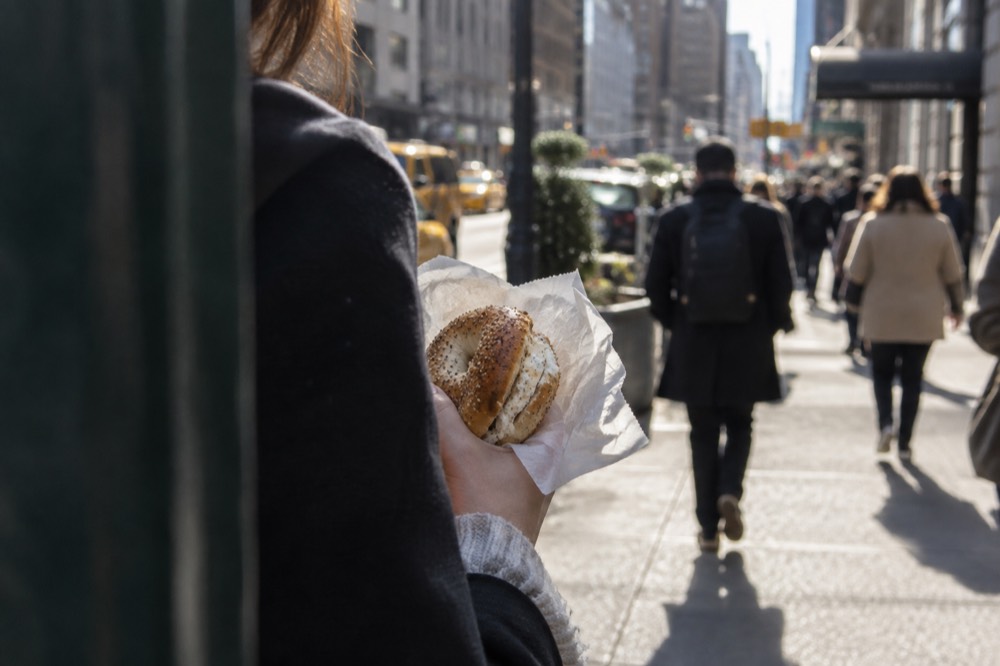
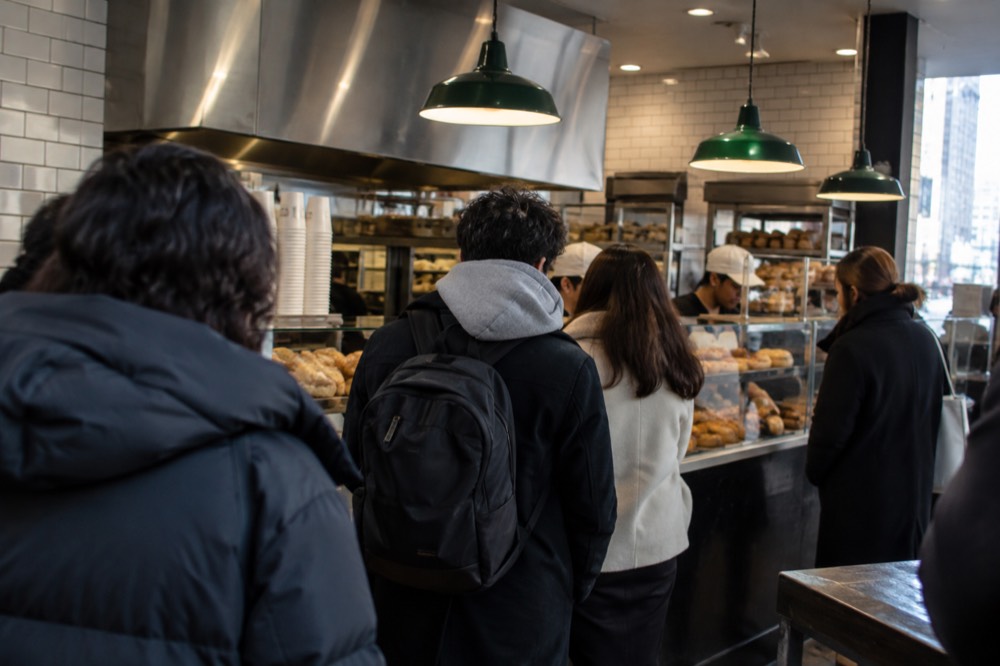
Payment is fast and often cash-friendly. Most counters move the line quickly and expect you to have your order in mind before you reach the register. On a weekend morning at a popular shop the line can stretch out the door, and it moves faster than it looks because the orders are short. Nobody is deciding between menus. They are saying two sentences and stepping aside.
Common Bagel Mistakes Visitors Make
The three mistakes that matter are buying bagels near major attractions out of convenience, eating one hours after it was baked, and assuming the famous name on the sign guarantees the fresh batch. Location is the worst predictor of bagel quality in New York, because the shops nearest the tourist corridors face the least pressure to turn over hot product. Walking ten minutes away from your hotel almost always improves the bagel.
The first mistake is the most expensive in quality terms. A shop that sells primarily to people who will never come back has no market reason to bake in small batches all morning. It can bake once at dawn and sell the stiffening inventory all day. The shops that bake continuously serve a clientele that would notice, and would say so, loudly, in person and in reviews.
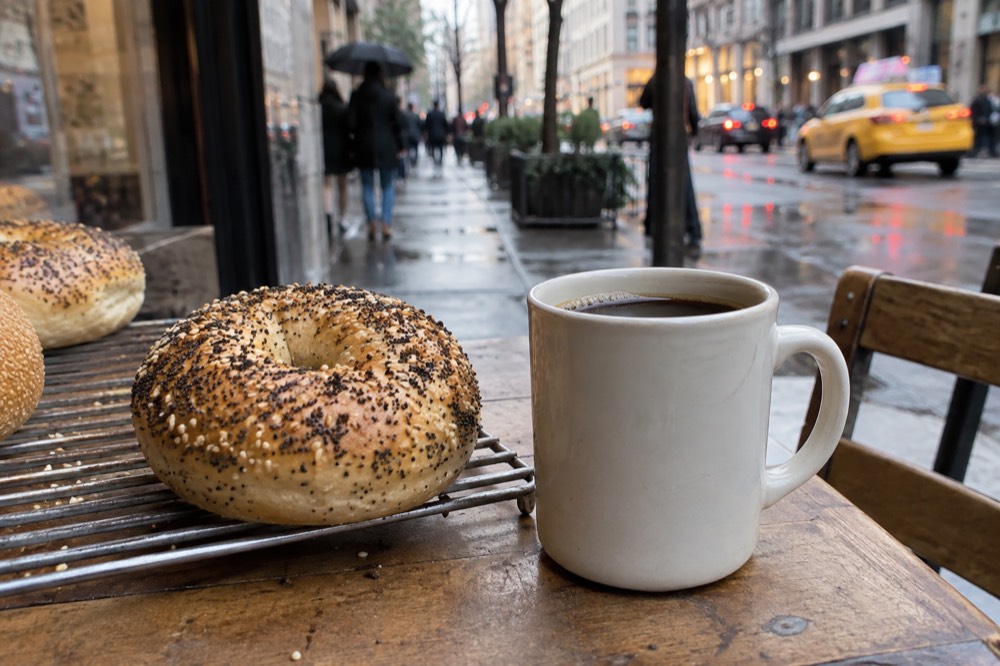
The second mistake is timing a bagel stop like a lunch stop. The peak is early. A shop that opens at six has its best product between six and nine, and by the time most visitors are out and about, the morning batches are gone. The fix is to make the bagel stop the first thing on the itinerary rather than the mid-morning filler. This also happens to be when the lines are shortest at the shops that matter.
The third mistake is treating the bagel as a vehicle only. A bagel with butter is fine, but the preparations New York is actually known for, the lox sandwich, the egg-and-cheese, the scallion cream cheese on a warm everything bagel, are worth ordering properly at least once. If your trip includes a food walk, the NYC food tours guide covers guided options where someone else handles the ordering, and the Greenwich Village guide covers a neighborhood with a deep bench of old bakeries and slice shops worth pairing with a morning bagel.
How to Build a Day Around a Bagel in NYC
A well-built bagel day starts early at a counter near your hotel, moves to a walkable neighborhood while the morning is quiet, and puts the paid attraction midday when bagel lines have died and museum lines have not yet peaked. The subway keeps it cheap: a ride is $3.00, and with OMNY the $35 weekly cap applies automatically, with no pass to buy, as long as you tap the same card every time.
The transport detail is worth a paragraph because most guides still get it wrong. The MetroCard era of buying a 7-day unlimited pass at the airport is over: the MTA stopped selling and refilling MetroCards as of 1 January 2026, and the value that the unlimited pass used to provide now arrives automatically through the $35 OMNY weekly cap. Tap the same credit card, debit card, phone, or OMNY card at every turnstile and the system stops charging you after the cap. Tap a different card by accident and that ride does not count toward it, so pick one and stick to it. The details are on the MTA's OMNY page.
The shape of the day matters more than the specific stops. Morning: bagel, eaten within sight of the shop that baked it. Mid-morning: a walk, because the city's most interesting blocks are between the bagel counter and the museum, not around either. Midday: the paid attraction, timed entry booked ahead. Afternoon: a second food stop in a different neighborhood, which is where a guided walk earns its keep, because a guide routes you past the counters you would never find. If you are planning the wider trip, the things to do in NYC page is the full inventory, and the best pizza in NYC guide is the natural evening sequel to a morning of bagels.
| Time | Stop | Why it works at that hour |
|---|---|---|
| 7:00-8:30am | Bagel counter near your hotel | First batches are out, lines are short |
| 9:00-11:00am | Neighborhood walk | Streets are quiet before the attractions fill |
| 11:00am-2:00pm | Timed attraction | Bagel crowds gone, museum crowds manageable |
| Mid-afternoon | Second neighborhood, coffee | Counter staff have time to talk |
| Evening | Pizza or a food tour | The proper bookend to a carb-forward day |
If the attraction half of the day is the expensive half, it is worth pricing the bundle options before you commit to individual tickets. The passes below cover the decks, museums, and food walks that pair naturally with a bagel morning, and the savings depend entirely on how many of the five you actually use.
For travelers who only want one decision rather than five, the fixed five-attraction pass is the simplest version of that trade, and it is the one most first-time visitors end up happiest with when their itinerary is already locked.
One last thing worth knowing: the bagel is the city's most democratic food. The same counter serves the person in the suit and the person in the moving truck, and both get the same bagel, from the same batch, at the same price. Find a shop that boils, go when the ovens are running, order in two sentences, and you will eat as well as anyone who lives here.
Common Questions About Bagels in NYC
The questions visitors ask most are what to order, whether to toast, which single shop is the best, and whether the famous shops are worth the lines. The honest answers: order a sesame or everything bagel with scallion cream cheese, skip the toast if the bagel is warm, accept that no single shop wins by consensus, and treat the famous names as one stop on a comparison rather than the whole plan.
What is the best bagel shop in NYC?
There is no settled answer, and locals argue about it constantly. Ess-a-Bagel, Russ & Daughters, Tompkins Square Bagels, and Best Bagel & Coffee all have serious followings in Manhattan, and Brooklyn partisans will nominate their own. The most reliable approach is to compare two or three in one morning while the batches are fresh.
Should you toast a New York bagel?
If it came out of the oven within the last hour, no. A fresh bagel needs nothing but the filling. If it has been sitting in a basket, toasting is standard and nobody will judge you. The mistake is toasting reflexively at a shop that is actively pulling hot bagels.
What should a first-time visitor order?
An everything or sesame bagel with scallion cream cheese is the safest excellent order. If you want the full New York experience, order it with lox, capers, and onion, which is the city's signature preparation and worth doing properly at least once.
Why do New York bagels taste different?
The short boil before baking is the main reason: it sets a crackled crust and keeps the interior dense and chewy. Freshness does the rest, because a bagel baked an hour ago and a bagel baked six hours ago are close to different foods.
Are bagels in NYC expensive?
A plain bagel with cream cheese is one of the cheapest filling meals in the city, and even the lox preparations cost less than most restaurant lunches. The price climbs at the famous sit-down cafés, but a counter bagel remains a budget traveler's best friend.
When do bagel shops sell out?
Many good counters bake through the morning and wind down by early afternoon, and the most popular preparations can run out on weekends. Going early is the only reliable strategy, and it has the side benefit of getting you the freshest product of the day.