NYC Christmas Markets: Where to Go, What They Cost, and What to Skip
New York's Christmas markets cluster in three Manhattan squares and one Brooklyn block, and the honest difference between them is less about shopping than about what kind of crowd you want to stand in.
Short answer
The main NYC Christmas markets are the Winter Village at Bryant Park, the Union Square Holiday Market, and the Columbus Circle Holiday Market, all running through the holiday season into early January. Admission to every one of them is free; you pay only for what you buy. The Dyker Heights Christmas lights in Brooklyn are a separate, residential spectacle, best reached by guided tour.
New York runs its holiday shopping through three Manhattan squares and a scattering of pop-ups, and every December the same argument breaks out about which one is worth the trip. The honest answer is that the markets are free to enter, packed on weekend afternoons, and mostly selling the same categories of goods: gifts, ornaments, and food you eat standing up. What actually separates them is scale, setting, and how well each one pairs with the rest of your day.
This guide, part of the New York City Travel Guide, walks through each market, what a visit realistically costs, the timing that matters, and the one Brooklyn detour that outshines them all. It draws on verified pricing and operator data rather than the recycled lists that still mention markets that no longer run.
Which NYC Christmas Markets Are Actually Open?
New York's headline Christmas markets are the Winter Village at Bryant Park, the Union Square Holiday Market, and the Columbus Circle Holiday Market, all free to enter and all running through the holiday season into early January. Smaller pop-ups appear around Grand Central, the Seaport and Brookfield Place in lower Manhattan, while the Dyker Heights Christmas lights in Brooklyn are a residential display rather than a market. None of the three main markets charges admission at the gate.
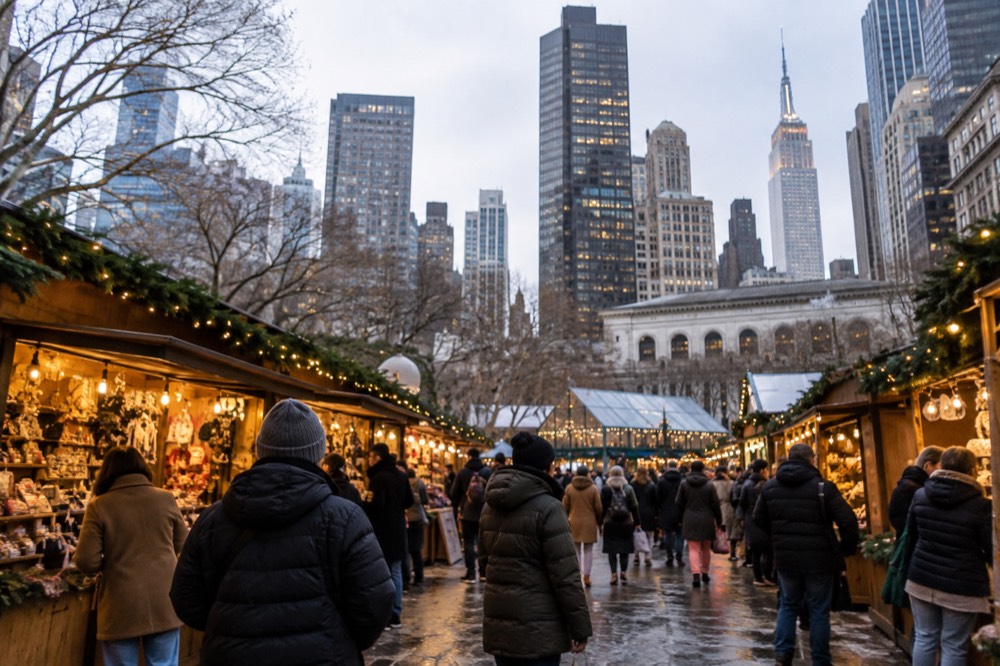
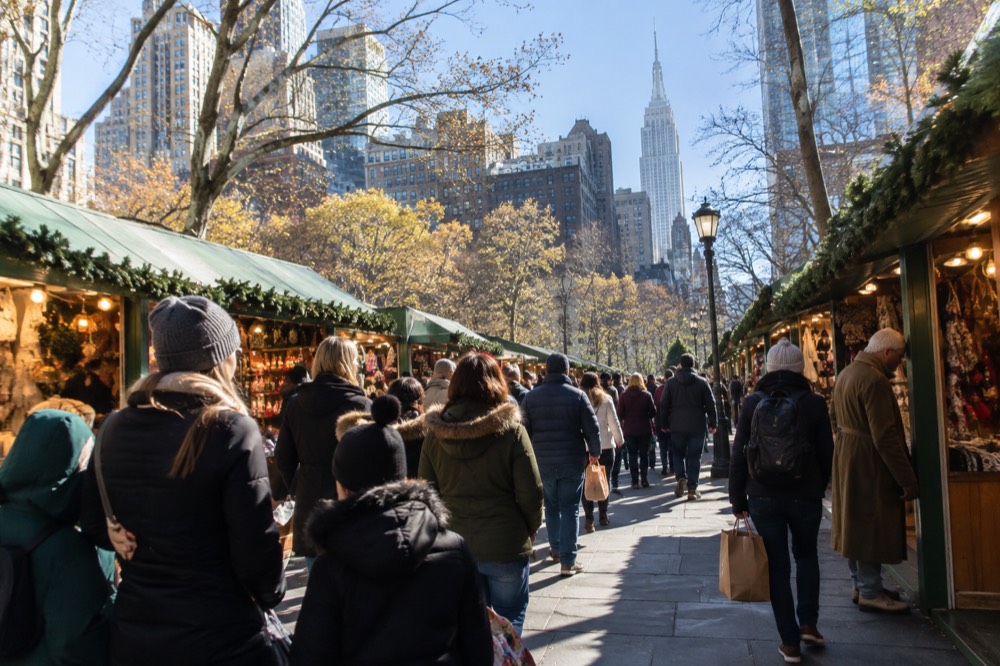
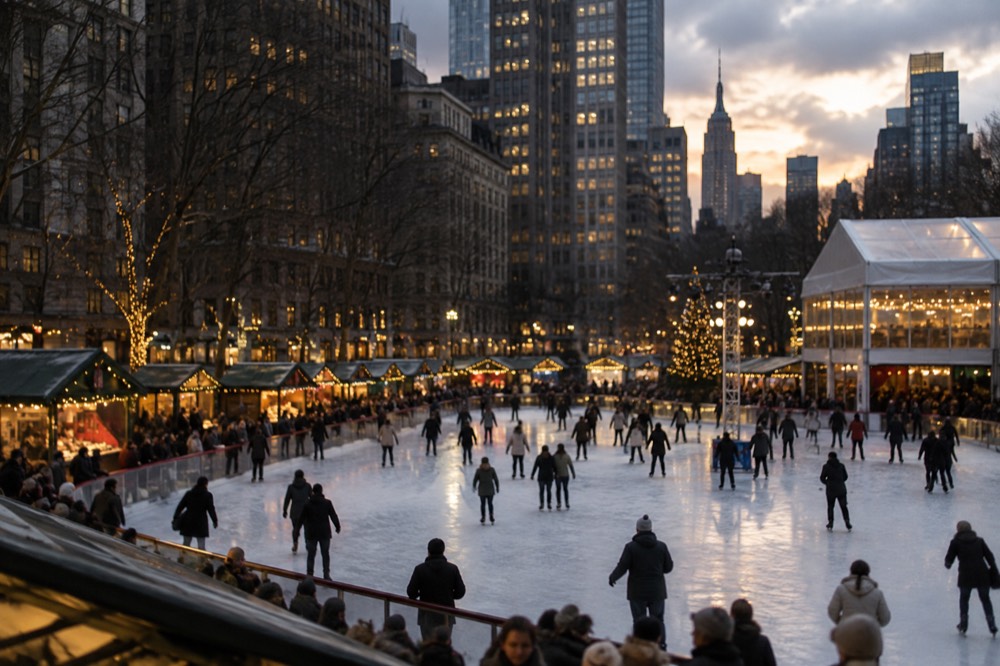
The Winter Village at Bryant Park is the biggest of the set, wrapping the lawn behind the New York Public Library in wooden chalets, with an ice rink at its center. Union Square is the most compact and the most crowded per square foot, sitting under the holiday lights around the park's south plaza. Columbus Circle is the smallest and the most pleasant to browse, ringed against the southwest corner of Central Park, which makes it the natural add-on to a park or museum afternoon.
A note on what is not on this list: older guides still send people to holiday markets that have closed or moved. Confirm before you travel that a specific pop-up is running this year, because the smaller ones change venues and dates annually. The three main squares are the reliable core.
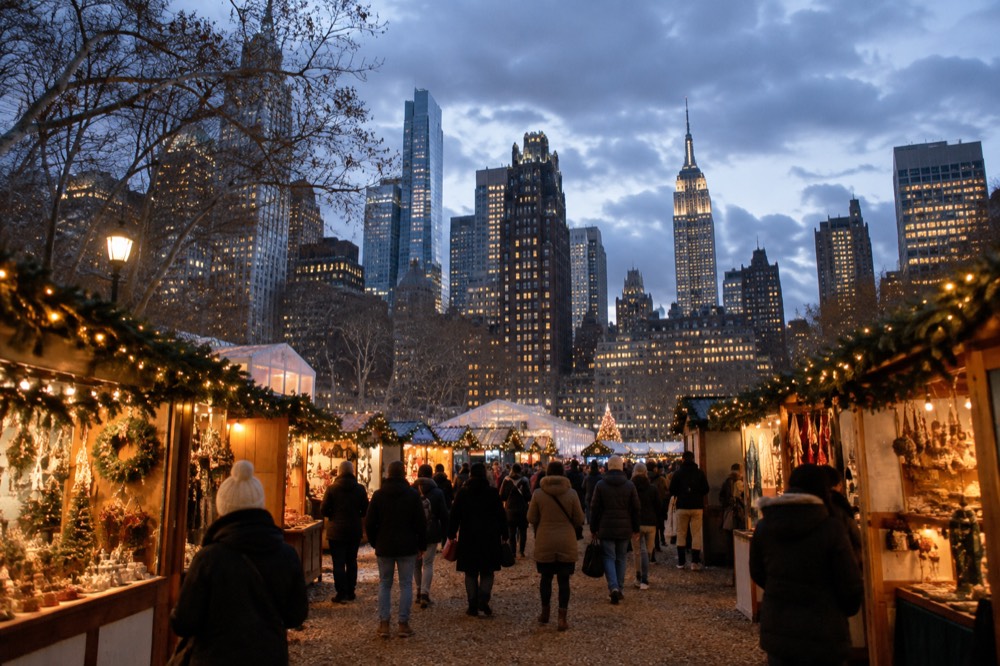
The seasonal timing matters more than most visitors plan for. December is the peak month for everything on this page, and the markets build steadily from late November to the week before Christmas, then thin out. If your trip falls between Christmas and New Year's Eve, expect the markets to still be running but with lighter vendor rosters and heavier tourists overall, since the city is at its annual crowd peak around the tree at Rockefeller Center.
How Much Does a Visit to the NYC Christmas Markets Cost?
Entry to every major NYC Christmas market is free: Bryant Park, Union Square and Columbus Circle all charge nothing at the gate, and you pay only for food, gifts and skating if you choose it. The Dyker Heights lights are free to walk through since they are private houses, though a guided bus tour runs from $63 per person. A realistic budget for a market afternoon is $20-$40 per person for food and a drink.
The markets are shopping events, not ticketed attractions, and that shapes the economics. A family of four can spend an hour at Union Square, buy hot chocolate and a pretzel, and be out for under $30. The same family can spend triple that at Bryant Park the moment ice skating enters the picture, because skate rental and rink time are where the Winter Village makes its money back on free entry.
| Cost item | Typical range | Notes |
|---|---|---|
| Market entry (all three) | Free | No gate fee at any main market |
| Food and drink per person | $8-$20 | Hot chocolate, pretzels, savory snacks vary by vendor |
| Gifts and ornaments | $10-$60 | Boutique pricing, not bargain pricing |
| Bryant Park ice skating | Rental fee plus deposit | Check the rink's official page for this season's rates |
| Dyker Heights guided tour | From $63 per person | Bus tour from Manhattan, about 3 hours 45 minutes |
Treat those food and gift figures as planning ranges, not promises. Vendors set their own prices and they shift year to year; check the boards at the stalls. What does not shift is the free entry, which is consistent across all three Manhattan markets and is worth knowing before you budget a family day around them.
One pairing worth the money: the Dyker Heights Christmas lights tour runs about 3 hours 45 minutes from $63 per person and handles the subway-and-bus puzzle of reaching a residential Brooklyn corner most visitors never find on their own. The houses go all out every December, and the tour's 4.5 rating across 922 reviews reflects how reliably the display delivers. Check availability
What Is the Best Time of Day to Visit the Christmas Markets in NYC?
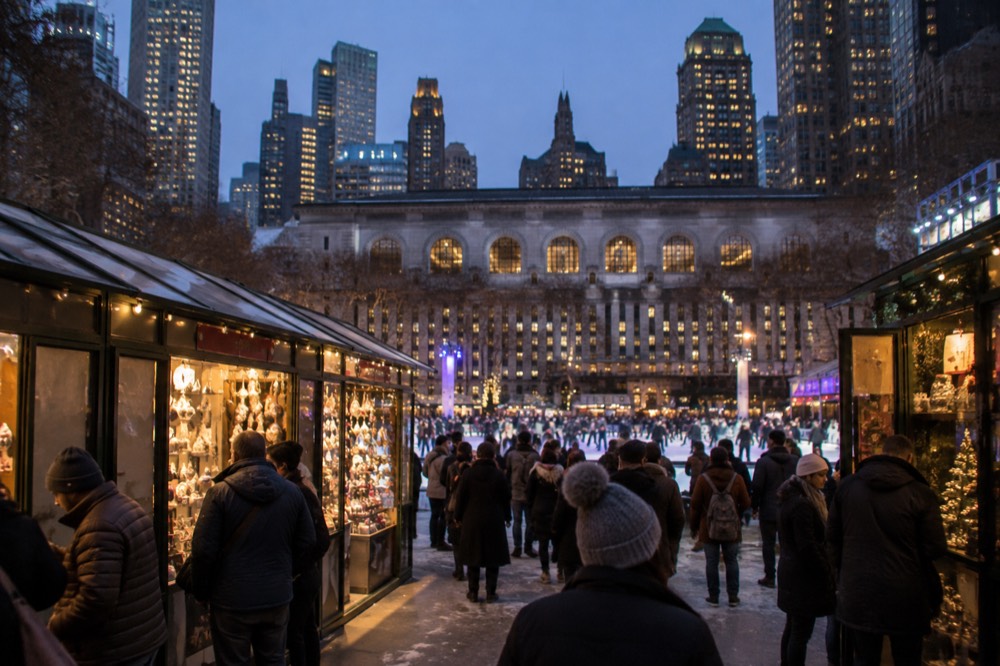
Weekday mornings and early afternoons are the calmest window for every Manhattan Christmas market, while weekend afternoons from roughly 2pm to 6pm are the most congested and least enjoyable. The markets look best after dark, when the lights are on, so the sweet spot is a weekday evening around 5pm to 7pm: lit up, lively, but before the post-dinner surge. Avoid the two weekends before Christmas entirely if you dislike crowds.
The crowd math is simple. The markets sit next to major subway stations, Union Square and Columbus Circle especially, and December weekends pour both tourists and locals into the same few plazas. A Saturday at 3pm at Union Square is closer to a mosh pit than a shopping stroll. The same market on a Tuesday at 11am is genuinely pleasant, and vendors have time to talk.
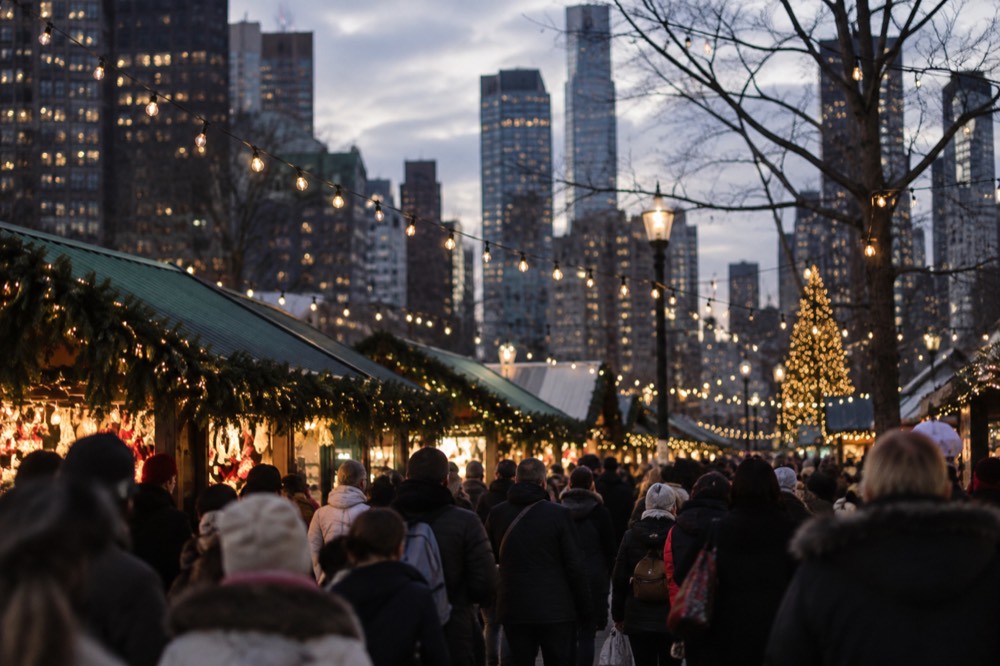
Dark changes the experience more than the clock does. These markets are built around light strings and illuminated chalets, and an evening visit photographs and feels entirely different from a midday one. If you can only pick one slot, aim for the hour around sunset: you get the lights coming on, the food vendors at full steam, and a crowd that has not yet peaked.
For the full seasonal picture, including the tree lighting and the window displays that pair naturally with a market walk, see Christmas in NYC: the complete guide.
Bryant Park Winter Village or Union Square Holiday Market: Which Is Better?
Bryant Park suits visitors who want a full afternoon: a large market, an ice rink, food kiosks and space to wander, all behind the New York Public Library in Midtown. Union Square suits visitors who want a dense, fast, classic market hit and are staying downtown. Bryant Park is bigger and better for families; Union Square is better for a short visit. Choose by where your day already points, not by quality.
Bryant Park's advantage is composition. The market rings the lawn, the rink fills the middle, and the surrounding blocks put you within a short walk of Rockefeller Center, Times Square and the library itself. That makes it the anchor of a Midtown holiday day: market in the afternoon, Rockefeller Center Christmas tree after dark, and a show or observation deck to close.
Union Square's advantage is density and position. The stalls pack into the park's south and west sides, and the surrounding neighborhood, the East Village, Greenwich Village and NoHo, gives you better food options within a few blocks than any market stall will. It pairs naturally with a downtown itinerary, and the 4, 5, 6, L, N, Q, R and W trains all stop right there.
| Market | Setting | Best for | Weakness |
|---|---|---|---|
| Bryant Park Winter Village | Midtown, behind NYPL | Families, skating, a full afternoon | Biggest weekend crowds |
| Union Square Holiday Market | Downtown, major subway hub | A fast, dense market visit | Cramped at peak times |
| Columbus Circle Holiday Market | Central Park corner, near Midtown West | Pairing with Central Park or an uptown museum | Smallest vendor count |
| Dyker Heights lights | Residential Brooklyn | A spectacle evening, not shopping | Requires a long subway ride or a tour |
Columbus Circle is the quiet third option and the one locals rate highest for pleasant browsing. It sits at the southwest entrance to Central Park, which means you can exit the market straight into the park, walk south past the ice and the towers, and end up at the Bryant Park or Midtown lights within a half hour.
Can You Pair the Christmas Markets with Other Holiday Attractions?
Yes, and pairing is the right way to do them, since a market alone fills an hour at most. Bryant Park pairs with Rockefeller Center and the Midtown window displays in a single walkable loop; Columbus Circle pairs with Central Park and the Museum of Modern Art; Union Square pairs with the East Village and Washington Square Park. The strongest evening pairing is a market at dusk followed by a Broadway show.
The geography does most of the work. Midtown's holiday cluster, the tree, the windows on 5th Avenue, the Winter Village and the deck at SUMMIT One Vanderbilt, sits inside a rectangle you can cross on foot in twenty minutes. Uptown, Columbus Circle hands you to Central Park. Downtown, Union Square hands you to the Villages. None of these pairings requires a subway ride longer than a few stops.
The evening pairing deserves special mention. A 5pm market wander followed by an 8pm curtain is the classic New York December night, and the Theater District sits ten minutes' walk from Bryant Park. MJ the Musical runs about two and a half hours at the Neil Simon Theatre, and its 4.8 rating across 2,786 reviews reflects a polished jukebox production with serious choreography.
For the deck pairing, SUMMIT One Vanderbilt sits next to Grand Central and its mirrored rooms are a natural stop before or after a Midtown market loop. Timed tickets keep the flow moving, so book a slot rather than walking up.
What Should You Actually Buy at the NYC Christmas Markets?
The markets reward buying what stalls make themselves: ornaments, knitwear, candles, jewelry and prepared food, where the maker is often standing in front of you. They punish bargain hunting, since prices are boutique-level and the same mass-produced goods appear at multiple markets. Budget for one or two considered purchases rather than a bag full, and treat the food as half the reason to go.
The vendor mix skews small-batch and craft, and the goods that travel well are the ones worth carrying home: a Christmas ornament beats a mug in luggage terms every time. Food is the other half. The stalls concentrate on hot chocolate, pretzels, savory snacks and sweets, and the lines at the food kiosks are often better indicators of quality than the gift stalls' signage.
| Category | Worth it? | Why |
|---|---|---|
| Ornaments and decorations | Yes | Light, packable, often handmade |
| Knitwear and scarves | Sometimes | Check quality; some is mass-produced |
| Jewelry and small crafts | Yes | Maker is usually present |
| Food and hot drinks | Yes | Half the experience |
| Branded merchandise | Rarely | Cheaper elsewhere |
A practical note on cash and cards: virtually every vendor takes cards now, so do not plan around cash. A more useful plan is arriving early enough that vendors have stock, since the best stalls sell out of popular items in the final week before Christmas.
How Do You Get to the NYC Christmas Markets?
All three Manhattan markets sit directly on subway lines: Bryant Park at Bryant Park-42 St on the 7, B, D, F and M, Union Square on the 4, 5, 6, L, N, Q, R and W, and Columbus Circle on the A, B, C, D and 1. A single subway ride is $3.00 with OMNY, and the $35 weekly fare cap applies automatically.
Dyker Heights in Brooklyn is the exception: it needs a long subway-plus-bus ride, which is why most visitors take a guided tour instead.
The fare side is simpler than most guides admit. There is no pass to buy any more: the MetroCard's 7-day unlimited was retired, and the equivalent value now arrives automatically as OMNY's $35 weekly cap, applied to whatever card or phone you tap, as long as you tap the same one every time. Tap your phone in the morning and your plastic card in the afternoon and the cap silently breaks.
For Dyker Heights, the honest arithmetic: the display sits deep in residential Brooklyn, roughly a D train ride plus a walk or a bus connection from Manhattan, and the December evenings are cold. The guided option, a bus tour from Manhattan running about 3 hours 45 minutes from $63 per person, removes the navigation entirely and is the reason it carries a 4.5 rating across 922 reviews.
Is December a Good Month to Visit New York Beyond the Markets?
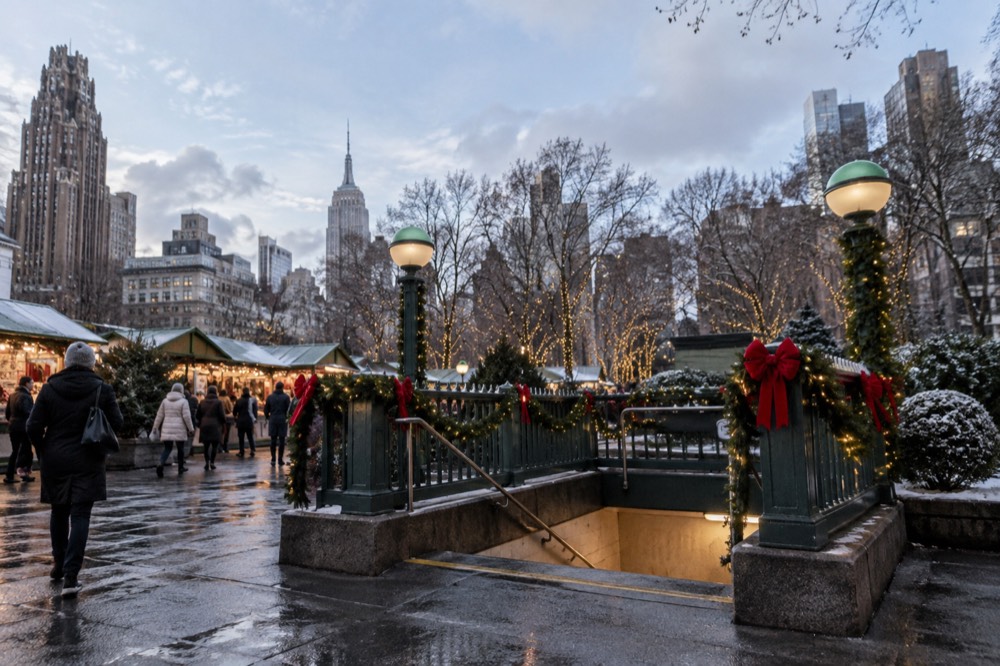
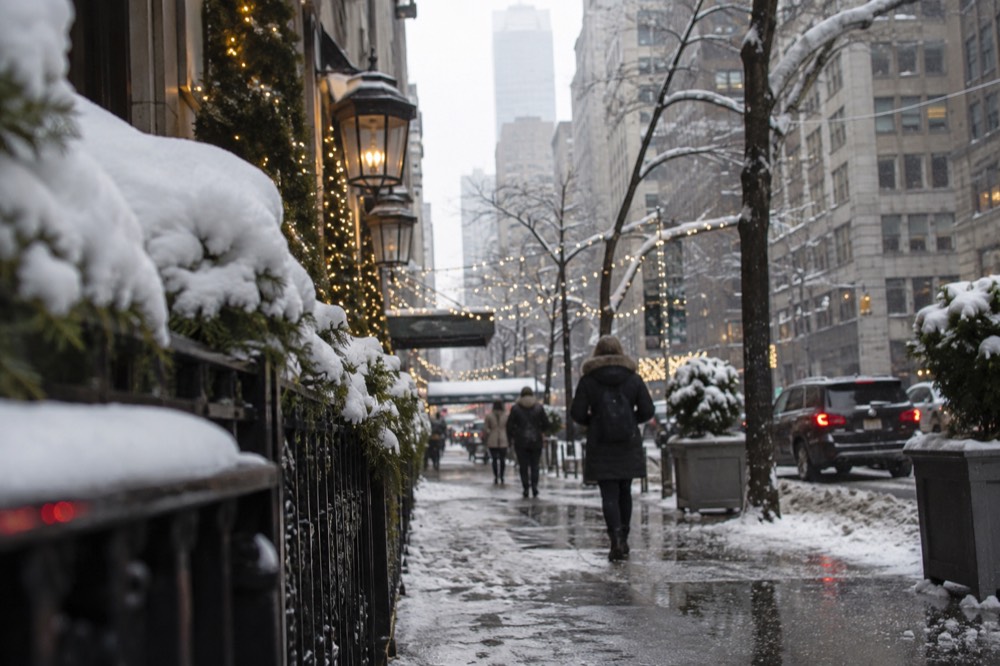
December is the city's most crowded and most atmospheric month at once, with holiday markets, window displays, the Rockefeller Center tree and ice rinks all running, offset by the year's heaviest tourist traffic and real cold. February, not January, is the snowiest month by the official Central Park normals, averaging 10.1 inches, and December averages 4.9 inches, so pack for slush rather than postcard snow.
The climate record is worth knowing before you pack. December's average high in Central Park is 44.3°F with an average low of 33.8°F, which means market browsing is cold but rarely brutal, and the classic failure is footwear: December slush ruins thin shoes. Layers, a real coat, and waterproof soles matter more than almost anything else on the packing list.
The crowd record matters too. New York welcomed 65 million visitors in 2025, and December concentrates an outsized share of them around the same ten blocks of Midtown. The weekend before Christmas is the single most congested stretch of the year for the areas in this guide. Early December, the first two weeks of the month, delivers nearly the full holiday layer, markets included, at a fraction of the crowd.
For the full seasonal breakdown, see NYC in Winter: what to expect month by month.
Common Questions About NYC Christmas Markets
The questions below cover the practical details visitors ask most: entry costs, the best market for families, how long a visit takes, and whether the Brooklyn lights belong on the same trip. Each answer is short and direct, and the details above expand on every one. The consistent theme is that the markets are free, walkable and best treated as one stop inside a larger holiday day rather than a destination on their own.
Are the NYC Christmas markets free to enter?
Yes. Bryant Park, Union Square and Columbus Circle all charge nothing at the gate. You pay only for food, gifts and optional extras like ice skate rental at Bryant Park.
Which NYC Christmas market is the best?
Bryant Park's Winter Village is the largest and best for a full afternoon with skating. Union Square is the densest and best for a quick visit downtown. Columbus Circle is the smallest and most pleasant to browse, and pairs directly with Central Park.
How long should I spend at a NYC Christmas market?
Plan on 45 minutes to 90 minutes per market without skating. With the Bryant Park rink or a meal built in, budget half a day.
Is Dyker Heights worth visiting in addition to the markets?
Yes, if the lights are a priority. Dyker Heights is a residential Brooklyn neighborhood where houses go all out every December, and it is a different experience from any market. A guided bus tour from about $63 per person handles the roughly 3 hours 45 minutes of transport and routing.
When do the NYC Christmas markets close?
The main markets run through the holiday season into early January, with vendor rosters thinning after Christmas. Confirm the current season's exact end dates on each market's official page before you plan the final week.
What should I wear to the Christmas markets in New York?
Real layers, a warm coat and waterproof-soled shoes. December in Central Park averages a high of 44.3°F and a low of 33.8°F, and the slush between stalls is what ruins thin footwear, not the temperature alone.
If the evening slot is what you are planning around, the Theater District option in that set is the one to lock first: weekend seats for the big musicals go fast in December, and a market at dusk followed by an 8pm curtain is the classic New York holiday night.
The last word on planning: pick one Manhattan market, not all three. Pair it with whatever your day already contains, the tree, a museum, a show, a deck, and give Dyker Heights its own evening. That is a New York December that leaves time for the thing the markets cannot sell, which is a quiet hour somewhere warm afterward.