Are Luggage Lockers Safe in New York? What to Know Before You Stash Your Bags
A direct, sourced answer on whether luggage lockers are safe in New York, where to store bags, what never to leave behind, and how to spot a storage operation you should not trust.
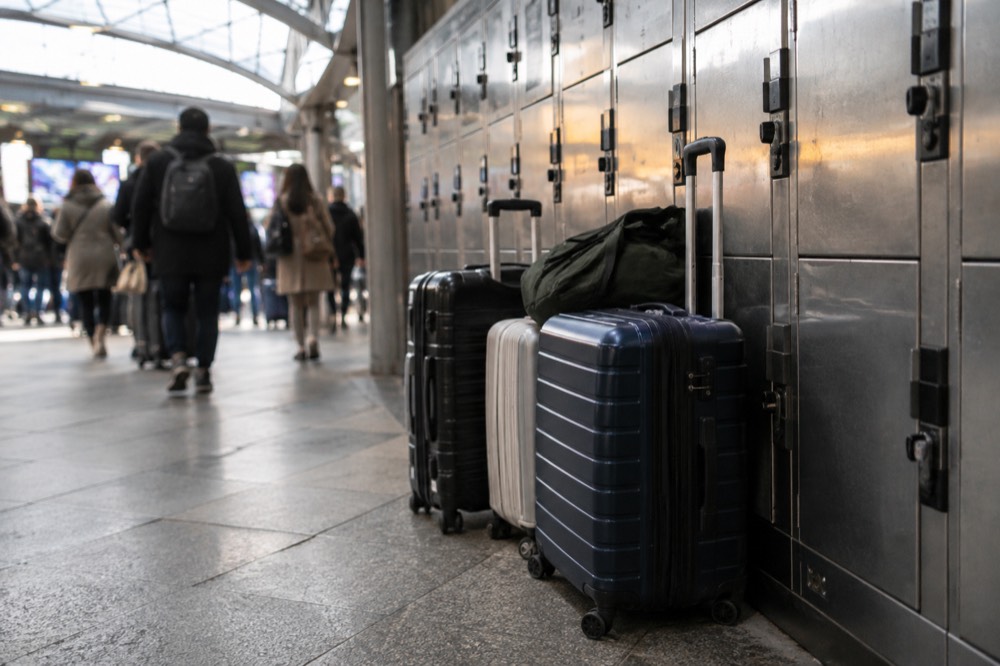
New York runs on a cruel clock: hotel checkout is usually late morning, your flight leaves in the evening, and the hours in between belong to the city. That gap is exactly when the luggage question hits. You want those hours back, and the answer is storage, whether that means a proper locker, a staffed left-luggage counter, or a shop that holds bags for a fee. The safety question is fair, and the honest answer has two halves: the physical risk to your bag is low almost everywhere, and the scam risk is concentrated in a small number of operations you can screen out in about two minutes.
Are Luggage Lockers Safe in New York?
Yes, luggage lockers and staffed storage in New York are generally safe, with theft rare at legitimate, staffed operations that tag your bag, hand you a receipt and keep cameras running. The real risks are not theft but two avoidable mistakes: leaving valuables and documents in a bag you cannot see, and trusting an unstaffed or unmarked setup with no paper trail. Choose operations with a person, a tag and a receipt, and the odds are firmly in your favor.
That answer comes with an important nuance. New York does not have banks of self-service luggage lockers the way some European train stations do. What the city mostly offers instead is staffed storage: a counter or a back room in a shop, hotel lobby or storage storefront where an employee takes your bag, attaches a numbered tag, hands you a claim ticket and shelves it. Some locations also have coded or app-opened lockers. Staffed storage is arguably safer than open lockers, because a human checks the claim ticket at pickup and nobody anonymous can walk off with a shelf of bags.
Theft from these operations is uncommon, and the reason is mundane: a storage business lives or dies on its reputation, and reviews punish a lost bag fast. What goes wrong more often is the stuff that is nobody's crime: a bag damaged by careless stacking, a mix-up at pickup during a rush, or a traveler who stored something they should have kept on their person. Treat storage as safe for clothes and shoes, and as the wrong place for passports and laptops, and you have removed most of the actual risk.
One more thing worth saying plainly. Do not conflate "safe" with "guaranteed." No storage operation, staffed or locker-based, insures the contents of your bag the way an airline does. If a policy caps their liability at a small amount per bag, that is standard across the industry, not a red flag by itself. The red flags are different, and the section on spotting a sketchy operation covers them.
If your storage day is really a sightseeing day, the hours you buy back are the point. These are the tours and passes that pair well with a bag-free afternoon:
Where Can You Store Luggage in New York?
Your four real options are your own hotel, dedicated luggage-storage storefronts and app-network shops, staffed left-luggage counters at a small number of transport hubs, and storage services that pick bags up from you. Hotels are the best value because most hold bags free for guests on checkout day. Storage storefronts and app-network locations are the most available, with shops, hotels and dry cleaners holding bags for a per-item fee that varies by location and size.
Start with your hotel, always. Nearly every New York hotel, from budget chains to luxury towers, will hold your bags on the day you check out, and most will also hold them on the day you arrive before check-in. This is usually free, though tipping a dollar or two per bag at pickup is normal practice. The staff tag your bag, keep it behind the front desk or in a secure room, and the whole arrangement sits inside a building with cameras, doormen and a business that knows your name. For pure safety per dollar, nothing else competes.
If you are not a hotel guest, or you need storage somewhere else in the city, the next tier is the dedicated storage operation. New York has storefront businesses built entirely around holding bags, plus app-based networks that sign up existing shops, hotels and cafés as storage points. You book a slot online or in the app, drop the bag, get a tag or a confirmation, and pay a per-bag rate for the day. Availability is the strength here: these networks cover Midtown, the Financial District, the Theater District and the areas around the major stations, so you can usually find a point within a few blocks of wherever you actually are.
The third option, staffed counters at transport hubs, is thinner in New York than in Europe. Grand Central Terminal has operated a bag-check service, and a handful of bus terminals and specialty services have held bags at times, but availability at Penn Station and the airports is limited and changes often, so never build a plan around a station locker without confirming the service exists on your travel date. Where a staffed counter does operate, it is among the safest choices: a fixed location, employees, tags and a claim-check system.
The fourth option is pickup-based storage, where a service collects your bags at your hotel or apartment, stores them in a warehouse and returns them at a time and place you choose, including the airport. This trades a small amount of control for real convenience on a tight departure day. It is safe with established operators, and the screening rules below apply to it the same as to any counter.
| Storage option | Typical cost | Best for | Main caution |
|---|---|---|---|
| Your own hotel (checkout day) | Usually free, tip expected | Guests with a same-day departure | Only helps if your day is near the hotel |
| Storage storefront or app-network shop | Per bag per day, varies by location and size | Non-guests and mid-day sightseeing loops | Quality varies by individual location, read recent reviews |
| Staffed hub counter | Per bag per day where available | Arriving or departing via a major station | Availability in New York is limited and changes, confirm first |
| Pickup-and-return service | Per bag per day plus booking | Tight departures and airport handoffs | You are apart from the bag longer, keep valuables with you |
Whatever option you choose, book the storage before you need it on busy days. Summer weekends and holiday weeks fill the best-located storage points first, and the leftover options are the ones nobody wanted. If you are planning a full sightseeing day around your stored bags, it helps to lock the big-ticket items early too.
Not sure the pass fits your day? The honest test is whether you will use all five choices. If your bag-free day is a two-attraction afternoon before an evening flight, skip the pass and book single tickets instead.
What Should You Never Leave in a Locker or Storage Spot?
Never store passports, wallets, cash, medication you may need, electronics with your data on them, house or car keys, or anything legally sensitive. Storage protects suitcases, not lifelines. The rule is simple: if losing it would end your trip or your identity, it rides on your body in a crossbody bag or money belt, not in a bag on a shelf you cannot see. Clothes and shoes can be replaced in New York in an afternoon.
The passport rule is the one with the hardest consequences. A lost passport in a foreign city means a visit to your consulate, forms, fees and days of waiting, and it can strand you past your flight home. There is no sightseeing convenience worth that trade. Carry it in a zipped inner pocket or a money belt, and carry a phone photo of the ID page as backup, plus a photocopy stored separately in your luggage.
Medication deserves its own line. If you take anything on a schedule, heart medication, insulin, an EpiPen, keep a full day's supply on your person even if the rest of the supply sits in the stored suitcase. The same logic applies to anything you would need urgently if the storage point had a problem, a fire, a closure, a staff mix-up, and could not return your bag for hours. Rare does not mean never.
Electronics are a judgment call. A laptop or tablet left in a stored bag is a data risk as much as a theft risk, and it is also the single most attractive item in the bag to anyone with bad intentions. If you do not need it for the day, the safer play is to leave it at the hotel in a room safe, not in a bag handed to a third party. Cameras and phones you will carry anyway.
| Keep on your body | Safe to store | Judgment call |
|---|---|---|
| Passport and other ID | Clothes and shoes | Laptop or tablet |
| Wallet, cards and cash | Toiletries and duplicates | Camera bodies and lenses |
| Keys to home or car | Books and printed guides | Prescription medication beyond one day |
| Phone and charger | Empty duffels and packing cubes | Jewelry of sentimental value |
| A day's medication | Souvenirs and gifts | Paper documents you also have digitally |
One habit ties all of this together: photograph the bag before you hand it over, and photograph the tag number. If there is ever a dispute about damage or a mix-up, a timestamped photo of the bag's condition settles it. It takes ten seconds.
How Do You Spot a Sketchy Luggage Storage Operation?
Screen for six things before you hand over a bag: a staffed location with posted hours, a numbered tag and a matching receipt, camera coverage you can see, a real booking trail through a known platform or storefront, recent reviews that mention the location specifically, and a liability policy stated in writing. Fail two or more of these and you should walk, because in New York a better option is almost always a few blocks away.
The tag and receipt are the foundation. A legitimate operation attaches a tag to your bag, gives you a claim ticket, and matches the two at pickup. If the process is "put it over there and I'll remember," that is not a system, it is a hope. The receipt also matters for a second reason: it proves the custody arrangement existed. Without it, you have no record that the shop ever took your bag at all, and that is exactly the situation a dishonest operator wants.
Cameras and visibility follow. Good storage happens in a space you can see, a counter, a shelf area behind a barrier, a room with the door in view of the register. Storage that disappears into an unmarked back room, a basement you cannot see into, or an alley door is not necessarily a scam, but it removes every safeguard that makes storage safe. The same test applies to app-network points: a dry cleaner holding bags behind its counter in full view is a different proposition from a bar that stacks suitcases next to a fire exit.
Reviews do real work here, but read them correctly. Ignore the platform's overall rating and look for reviews of the specific location, written recently, that mention the bag handoff itself. A location whose reviews are all about coffee or sandwiches, with no mention of storage, may be new to holding bags. A location with reviews mentioning long waits at pickup, tags that did not match, or bags returned damp tells you what you need to know. Two minutes of reading is cheaper than a lost suitcase.
Finally, trust the booking trail. Established storage platforms and storefronts give you a confirmation with the location, the price, the hours and a support contact. An arrangement that exists only as a cash transaction with no record, or a person soliciting storage outside a station, is where actual losses happen. The classic versions are unsolicited offers to "watch your bag," a stranger near a terminal offering to store luggage in a van, and unmarked counters with laminated signs. Decline all three. New York has enough legitimate storage that you never need to gamble.
Is It Safe to Leave Luggage at Your Hotel Before Check-in or After Checkout?
Yes, and it is the safest option most travelers have. New York hotels hold bags for arriving and departing guests every single day, behind the front desk or in a dedicated room, with tags, claim tickets and building security around them. The arrangement is standard practice across the industry, usually free, and the risks are minor: congestion at peak hours, occasional mix-ups, and the same rule about not leaving valuables in any bag you hand off.
The mechanics are simple. You show your reservation or your room number, the bell desk or front desk staff tag each bag, and you get a claim ticket. On arrival days this frees you to start sightseeing hours before check-in opens, and on departure days it buys you the whole afternoon after checkout. During peak windows, the bag room at a large Midtown hotel can hold a hundred or more suitcases, which is why the tag system matters and why you should keep your ticket somewhere deliberate rather than in a coat pocket you will excavate at a taxi stand.
Two cautions keep the arrangement honest. First, the hotel holds your bag, not its contents: the same keep-your-passport-on-your-body rule applies to hotel storage exactly as it does to a locker. Second, do not confuse the bag room with a safe. If your room has a safe and you have a same-day return, the safe is the better spot for a laptop. If you have already checked out, the bag room is the option, and it is a good one.
The hotel option also pairs naturally with the city's biggest sightseeing loop, because a checkout-day bag hold turns a dead morning into a full day. If you are doing the classic circuit, the observation decks, the ferry, a museum, the planning question is which attractions to stack, and that is a pass question:
What About the Airport, Penn Station or Grand Central?
Airport storage in New York is limited and inconsistent across JFK, LaGuardia and Newark, so confirm before you count on it. Penn Station has no reliable public locker bank. Grand Central has historically offered a staffed bag-check service, but hours and availability change, so check current status on the terminal's official site before planning around it. The general rule for New York transit hubs: assume no lockers until a current, official source confirms otherwise.
There is a reason for the scarcity, and it is not a secret: unattended storage in major transit hubs has been a security concern in American cities for decades, which is why the European-style wall of coin lockers largely never came to New York. What exists instead is staffed service where it exists at all, plus a wide network of private storage points in the blocks around each hub. Around Penn Station, around Grand Central and around each airport's transit connections, private storage locations cluster, and that is where most travelers actually end up.
If your plan is "store the bag at the station, sightsee, grab the bag, ride to the airport," invert it. Store the bag near your first sightseeing stop instead, retrieve it when the day is done, and then travel to the airport bag-light in reverse. The subway makes this easy. A single ride costs $3.00, and if you are riding repeatedly across a week, the automatic OMNY weekly cap of $35 handles the value with no pass to buy, since the MetroCard's old 7-day unlimited is no longer sold as of 1 January 2026. The site's guide to riding the New York subway covers the tap-to-ride mechanics in full.
Grand Central is worth a longer stop even without a bag to check. The terminal's main concourse is one of the city's great interiors, and the secrets are better than the sight: a whispering gallery near the Oyster Bar, a celestial ceiling with a deliberate painted error, and a landmark that survived demolition threats. A guided tour of Grand Central's hidden details turns a transit stop into a real sightseeing block, and it sits within walking distance of several storage points in the Midtown grid. The site's Grand Central Terminal guide walks through the rest of the building's corners.

The airport question has a second dimension: whether to store at the airport at all. If you have a long layover and want hours in Manhattan, you have a choice between carrying the bag in and out, or storing it somewhere in the city near your first stop. Carrying it in means hauling it through fare gates and up stairs, since many subway stations have limited elevator access. Storing near your first stop means one handoff and a free afternoon, which is usually the better trade. For a deeper look at the timing math, the site's guide to a New York layover covers the hours in detail.
Common Questions About Luggage Lockers in New York
Most questions about luggage safety in New York come down to four decisions: hotel versus paid storage, what stays on your body, how to screen an operator, and whether to trust a transit hub. The short answers are: use your hotel when you can, keep documents and medication on your person, demand a tag and a receipt, and assume station lockers do not exist until an official source says otherwise. The details below handle the rest.
Are luggage lockers safe in new york?
Yes, when they are part of a legitimate, staffed operation with tags, receipts and cameras. Theft from established storage businesses is rare. The avoidable risks are leaving valuables in a stored bag and using an unstaffed or unmarked setup with no paper trail. Screen the operation, keep your passport and medication on your body, and photograph the bag before handoff.
Do New York subway stations or Penn Station have luggage lockers?
Assume no. New York's transit hubs do not have the open locker banks common in European stations, largely for security reasons. Penn Station has no reliable public locker bank, and any staffed bag service at Grand Central should be confirmed on the terminal's official site before you plan around it. Private storage points cluster in the blocks around every major hub, and those are the practical option.
Is it safe to leave luggage with a shop I found through a storage app?
Usually, yes, if the location has recent reviews that specifically mention bag storage, a visible storage area, and a booking confirmation with the price and hours. The platform gives you a paper trail the shop alone would not. Read the location's reviews rather than the app's overall rating, and apply the same tag-and-receipt test at the counter.
Will my hotel hold my luggage after checkout for free?
In nearly all cases, yes, and usually without a charge, though tipping a dollar or two per bag at pickup is normal. The hotel tags your bag and gives you a claim ticket. It is the safest and cheapest option for same-day departures, and most hotels also hold bags for arriving guests before check-in opens.
What items should never go into stored luggage?
Passports and other ID, wallets, cash, keys, phones, a day's supply of any scheduled medication, and anything with sensitive data on it. Stored luggage should hold things you can replace easily: clothes, shoes, toiletries, books and souvenirs. The test is simple: if losing it would end your trip or your identity, keep it on your body.
Are lockers safe for luggage in New York overnight?
Overnight storage is a different product from a few hours of day storage, and not every location offers it. Where it exists, the same screening rules apply, with one addition: confirm the location's overnight liability terms and pickup windows in writing before you leave the bag. For a single night, your hotel, including one you have already checked out of, is usually the better answer.
One last planning note. The hours you buy back by storing a bag are only as good as what you do with them, and New York rewards a decisive afternoon. If the day is taking shape around you, these are the picks that fit a bag-free window best:
And if the bag-free afternoon is centered on Midtown, the deck next to Grand Central earns its slot on looks alone:
The site's full rundown of things to do across the five boroughs is the natural next stop for filling the hours, and the New York City Travel Guide homepage maps out the rest of the planning questions, transport, passes and neighborhoods, from the top. Store the suitcase, keep the passport, and go spend the day.